What is the cost of the proposed teacher pay raise?
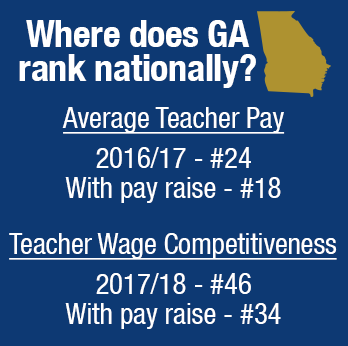 Gov. Kemp proposed a $5,000 raise for all public school teachers in Georgia. With roughly 115,000 teaching positions in the state, this pay increase would require an additional $575 million spent on school funding annually.
The state’s obligation to pay a portion of each employee’s salary into the Teacher Retirement System (TRS) of Georgia makes the true cost significantly higher. By law, the state pays 21% of TRS-eligible employee salaries in 2020, a percentage that has doubled since 2010. Taking employer contributions into account, the true cost of the proposed raise is at least $697 million.
Additional revenue must be raised to meet teacher needs
Georgia must raise revenue to provide for teacher salary increases. After 16 years of cuts to education totaling $9 billion in lost state funding, Georgia cannot afford to give significant raises without a sound plan to pay for them. Any attempt to rely solely on economic growth could leave the state in dire financial straits if the economy stalls. Adding additional revenue will provide the funds necessary to display a commitment to the teacher workforce and show the state is dedicated to public education.
Considerations
Local Control: School districts have the ability to waive certain laws in exchange for increased test scores. Districts given additional money are not compelled to provide teacher raises, even if that was the intent.
Incremental Raises: If policymakers decide to phase in the raise over a number of years (e.g. $1,250 pay increases for 4 years), the resulting pay increase would only slightly outpace inflation. During the first year, pay would only increase $425, or $35 per month.