
In July 2023, Georgia launched the Pathways to Coverage program, which provides a new Medicaid option to uninsured adults who make low-incomes and can report working, going to school or engaging in other qualifying activities for at least 80 hours per month. The program generally covers most of the same medical services as traditional Medicaid, including doctor visits, hospital stays and prescriptions. This brief provides policymakers and advocates with an abbreviated three-year update on eligibility and enrollment trends, program costs and potential program changes coming in January 2027. For more in-depth analysis and recommendations on program/system improvements, please access the Year 1 and Year 2 reports.
Key findings after three years of program enrollment:
- Only 13% of potentially eligible Georgians were actively enrolled, which left most uninsured Georgians from working households with annual incomes below the poverty level without access to affordable health care. Georgia still has the second highest rate of non-elderly adults without health insurance in the nation.
- For many of the Georgians who are eligible and successfully enroll, available data indicate that the program does not provide a stable source of health coverage; 43% of those ever enrolled in the program in the first three years lost their coverage. Often these coverage losses are due to issues like missing paperwork or income fluctuations rather than a failure to meet the work and other qualifying activities requirement.
- Health care benefit costs, like doctor visits and prescription refills, account for slightly more than half (54%) of the total $165.7 million in program spending.
Eligibility and Enrollment Trends
Less than one in every seven uninsured, low-income Georgians from working households were enrolled in the program as of June 30, 2026.[1],[2],[3]
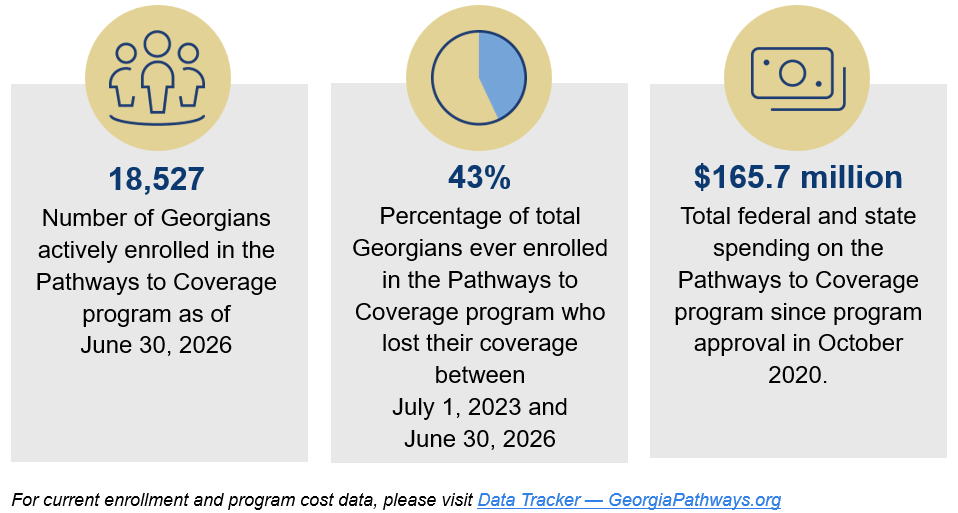
After three years of enrollment, 18,527 Georgians were actively enrolled in the program. That represents just 13% of uninsured Georgians aged 19-64 years old who were in households with at least one worker and who had annual household incomes less than 100% of the federal poverty level (FPL), which is less than $33,000 for a family of four.
Most active enrollees in the program were 19-34 years old (59%), female (76%), and identified as Black (50%) or Caucasian (37%).[4]
Some Georgians who are potentially eligible may face unique barriers to learning about, qualifying for and/or maintaining coverage in the Pathways to Coverage program. For example, older adults (50-64 years old) represented about 23% of uninsured, non-elderly adult Georgians who qualified for Pathways to Coverage in terms of age and income level, but represented only 10% of active program enrollees as of June 30, 2026.
Most active enrollees in the program gained coverage through employment or multiple qualifying activities.[5]
Among Georgians actively enrolled in the program as of June 30, 2026, most qualified through employment/self-employment (36%) or through multiple qualifying activities (30%). About 14% qualified as the parent/legal guardian of young children and 12% qualified through enrollment in higher education. The remainder gained eligibility through community service, a work program (e.g., a job readiness program) or were utilizing the short-term ‘Good Cause’ exemption after already having gained coverage through a qualifying activity.
The program’s two new qualifying activities for parents of young children and food assistance recipients were under-enrolled.
As part of Georgia’s 1115 demonstration waiver program extension, Georgia added two new qualifying activities in October 2025: 1) being a parent and/or legal guardian of a child under the age of six and 2) compliance with Supplemental Nutrition Assistance Program (SNAP) Able-Bodied Adults Without Dependents (ABAWD) program through completion of a work activity.[a] As of June 30, 2026, only 2,226 Georgians were actively enrolled in the new qualifying activity for parents of young children and zero Georgians were actively enrolled in the new qualifying activity for SNAP ABAWD recipients.[6] Because SNAP recipients must meet similar income and other eligibility requirements, the state’s SNAP enrollment metrics provide a helpful comparison and underscore under-enrollment in the two new Pathways to Coverage qualifying activities. For example, as of June 2026, over 126,000 adults with a net monthly income of less than 100% FPL were caregiving for a child under the age of six and enrolled in SNAP. Similarly, as of June 2026, over 43,000 Georgians were enrolled as SNAP ABAWD recipients.[7]
The program did not appear to provide a consistent source of health care coverage.
Of the 32,394 who were ever enrolled in the Pathways to Coverage program between July 1, 2023 through June 30, 2026, 43% lost their coverage. [8] Prior analysis indicates that most enrollees are not losing coverage because of failure to meet the qualifying hours and activities.[9] Rather, most of the enrollees who lost coverage during the renewal period were losing it for paperwork reasons, like failure to return the renewal packet. Outside of the renewal period, most were losing coverage because of transition to another category of Medicaid eligibility like pregnancy Medicaid or income fluctuations (e.g., inconsistent hours and unreliable wages are more common in low-wage jobs[10]). When people move in and out of Medicaid coverage, it can create higher administrative costs for the state, increased workload for state agency workers and higher out-of-pocket costs and delayed care for the people impacted.[11]
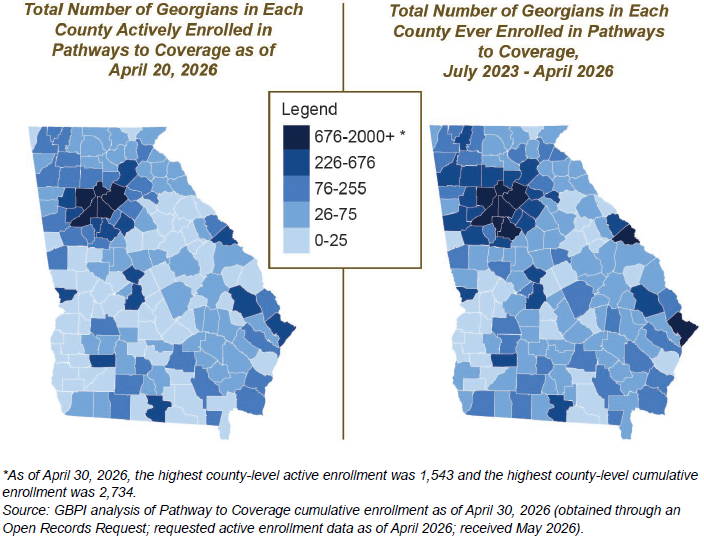
A majority of counties (70%) had 75 or fewer residents actively enrolled.[12]
The highest number of residents actively in the program by county were, as expected, clustered in densely populated metro areas like Atlanta. However, no single county stands out as enrolling a significantly higher proportion of its low-income uninsured population as of April 30, 2026.[b] In fact, among each county’s uninsured adults that would qualify for full Medicaid expansion under the Affordable Care Act,[c] only about five percent, on average, were actively enrolled in the program.[13]
Program Costs
Since program approval in late 2020, the program has cost $165.7 million, which amounts to about $8,945 per active enrollee in combined health care and administrative spending.[14]
Health care benefits accounted for slightly more than half (54%) of total program spending while administrative expenses like technology system upgrades accounted for 46% of total program spending since Pathways to Coverage was first approved in October 2020. In a departure from prior years, the majority of spending in the third year of program enrollment was on health care benefits alone.
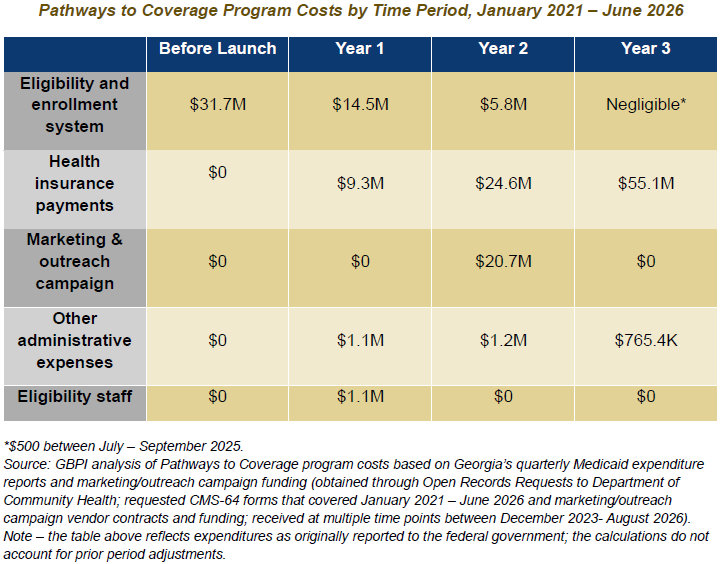
Overall, the state has covered about one in every four dollars spent (23%) and the federal government has paid the remainder.[15]
The program qualifies for Georgia’s standard 66% federal match on health care benefits; other administrative costs qualify for a 50%-90% federal match depending on the exact expense.[16] In total, the state has covered $37.3 million in program costs while the federal government has covered $128.4 million.
A required investment in program evaluation could prompt program changes.
The sub-category of ‘other administrative expenses’ represents one of the smaller expenses ($3.1 million total).[17] Most of that funding has supported the federally-required independent evaluation being led by Public Consulting Group. Program monitoring and in-depth analysis are critical for better understanding program impact and the taxpayers’ return on investment. The final evaluation report could also trigger a corrective action plan or even temporary suspension of program implementation depending on the results.[18] However, the independent evaluation results will not be available until March 2027 or after.
Proposed Program Changes
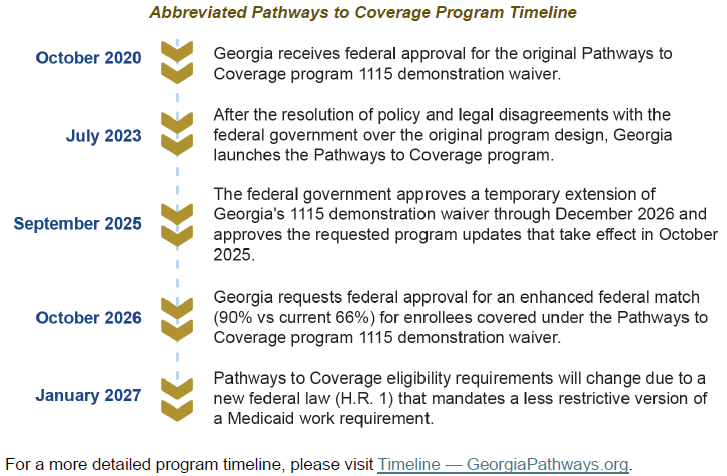
A less restrictive, federally-mandated work requirement creates the opportunity for more low-income, uninsured Georgians to gain coverage.
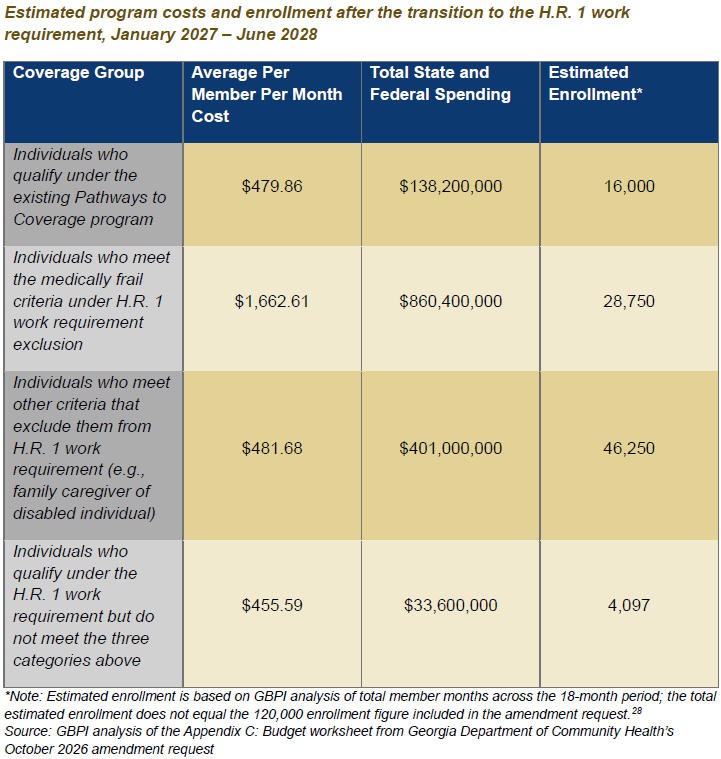
Currently under the Pathways to Coverage program, individuals must document at initial application and annual renewal that they are working, enrolled in higher education and/or engaged in another qualifying activity for 80 hours per month. Parents of children under age six, SNAP ABAWD recipients and family caregivers of adults enrolled in three of the Medicaid waiver programs also qualify. The new federal H.R. 1 Medicaid ‘community engagement’ requirement is less restrictive; specifically, it excludes certain groups from having to report work or other ‘community engagement’ activities.[19] This includes former foster youth, parents/caregivers of children 13 years old and younger, family caregivers of a disabled individual, disabled Veterans, certain medically frail individuals who cannot work, individuals participating in substance use disorder treatment, or Temporary Assistance for Needy Families (TANF) and SNAP recipients who already meet those programs’ work requirements. The harms of Medicaid work requirements are well-documented.[20],[21],[22] However, the transition to a less restrictive reporting requirement offers Georgia an opportunity to slightly expand Medicaid coverage to more low-income, uninsured adults. In July 2026, the state posted a public notice outlining its intent to request a change to the state plan to account for this transition to the H.R. 1 work requirement that would be effective on January 1, 2027.[23]
The state has requested a 90% enhanced federal match for individuals covered under the program.
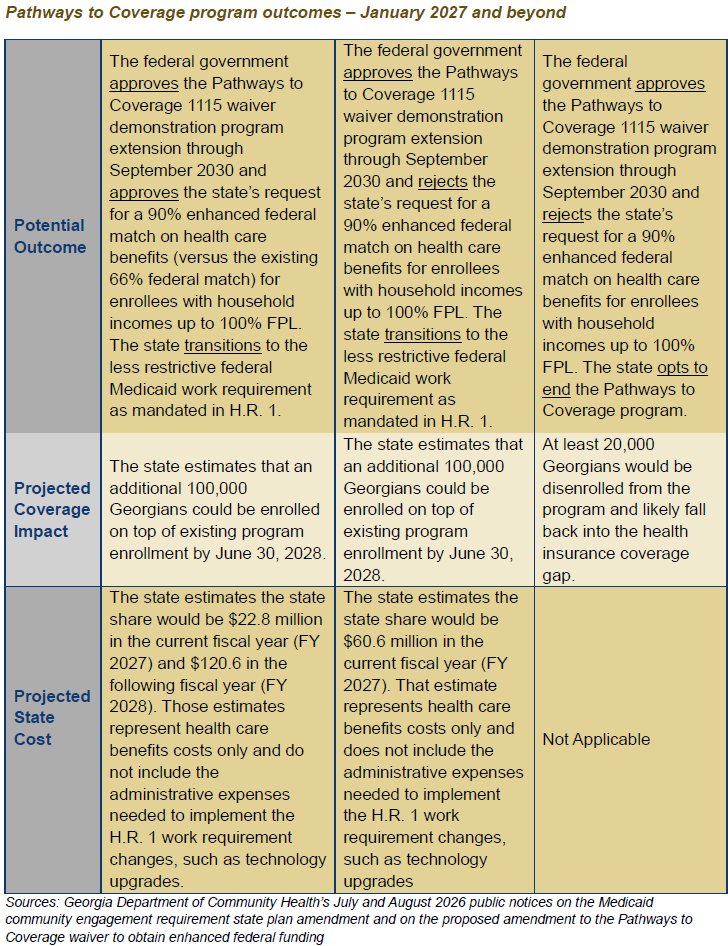
Currently, the federal government pays 66 cents on every dollar spent for Pathways to Coverage program enrollees to see the doctor, receive care at the hospital, fill a prescription and other benefits. In August 2026, Georgia’s Department of Community Health posted a public notice outlining its intent to submit an amendment to the existing Pathways to Coverage 1115 demonstration waiver extension and request an increase in the federal match funding for the program. In October 2026, the state officially requested that the federal government pay 90 cents on every dollar spent for health care benefits starting in January 2027.[24] To date, the enhanced federal match has only been approved for states that expand Medicaid eligibility to adults with annual household incomes up to 138% of the FPL; Georgia is requesting the enhanced match for program enrollees with annual household incomes only up to 100% of the FPL. The state specifically cites the additional individuals that must be covered after the transition to the less restrictive H.R. 1 ‘community engagement’ requirement, which includes individuals who may have higher average monthly costs like Georgians living with cancer or Parkinson’s disease. The state previously requested the enhanced federal match for the Pathways to Coverage program in 2019 and was denied.[25] It is unclear if the state’s new request will be approved; however, the state implies that it may be forced to end the program altogether without additional federal financial support.[26]
Summary
After three years of enrollment, the data show that Georgia’s Pathways to Coverage program has been costly for taxpayers, created unnecessary bureaucratic hurdles for both applicants/enrollees and state agency workers and failed to close Georgia’s health insurance coverage gap. Despite failed experiments with Medicaid work requirements in both Arkansas and Georgia, a Medicaid work requirement for certain non-elderly, non-pregnant adults with low incomes is federally mandated across most states starting in January 2027. For Georgia, the transition to the less restrictive federal Medicaid work requirement could result in up to 100,000 more Georgians gaining access to health insurance. Because it only provides coverage to adults with households up to 100% FPL, the Pathways to Coverage program costs more per enrollee than if Georgia were to slightly expand the income eligibility limited up to 138% FPL and unlock the enhanced federal match under the Affordable Care Act. If the federal government reinterprets existing federal policy by approving the state’s request to pull down that enhanced federal match on its existing Pathways to Coverage population (i.e., up to 100% FPL), it could significantly alter the Medicaid expansion landscape both in Georgia and across the nation. Regardless of the federal government’s decision, Georgia’s state-level policymakers should pursue additional solutions grounded in the real lives and needs of uninsured Georgians with low incomes and prioritize policies that expand access to affordable health care, strengthen the state’s eligibility and enrollment infrastructure and deliver a stronger return on investment for Georgia’s taxpayers.
Footnotes
[a] The approved 1115 waiver extension application from September 2025 and Georgia’s Medicaid Policy Manual both state that this qualifying activity entails compliance with the Supplemental Nutrition Assistance Program (SNAP) Able-Bodied Adults Without Dependents (ABAWD) program through completion of a work activity. However, as of June 2026, the Department of Community Health’s Pathways to Coverage website stated that the qualifying activity entails compliance with the Supplemental Nutrition Assistance Program (SNAP) Works Program, which is a voluntary employment and training program. It is unclear if this discrepancy is impacting enrollment under this qualifying activity.
[b] In mid-2026, the Department of Community Health stopped identifying the county names in requests for county-level enrollment data as per their new interpretation of 45 C.F.R. § 164.514(b)(2)(i)), which is a provision of the HIPAA Privacy Rule. As such, this report reflects only county-level enrollment data from July 1, 2023 – April 30, 2026.
[c] Full Medicaid expansion covers adults 19-64 years old who have annual household incomes at or below 138% of the FPL, which is less than $45,540 for a family of four.
Endnotes
[1] GBPI analysis of June 2026 enrollment data (obtained through an Open Records Request to Department of Community Health; requested active enrollment for June 30, 2026; received July 2026)
[2] Zhang, E., (2026, March, 6). Research note: Nearly 3 million uninsured adults would gain a path to Medicaid coverage if their states adopted ACA Medicaid expansion. Center on Budget and Policy Priorities. https://www.cbpp.org/research/health/nearly-3-million-uninsured-adults-would-gain-a-path-to-medicaid-coverage-if-their
[3]Zhang, E., (2025, April 10). Research note: Closing Medicaid coverage gap would provide 1.5 million uninsured adults path to affordable health coverage. Center on Budget and Policy Priorities. https://www.cbpp.org/research/health/closing-medicaid-coverage-gap-would-provide-over-15-million-uninsured-adults-path
[4] GBPI analysis of June 2026 enrollment data by age category, by sex, and by race/ethnicity (obtained through Open Records Requests to Department of Community Health; requested active enrollment for June 30, 2026; received July 2026 and September 2026).
[5] GBPI analysis of qualifying activity type among Pathways-eligible individuals (obtained through Open Records Request to Department of Community Health; requested number or percentage of active Pathways to Coverage enrollees by each qualifying activity as of June 30, 2026; received September 2026).
[6] GBPI analysis of June 2026 enrollment data (obtained through Open Records Request to Department of Community Health; requested number of active Pathways to Coverage enrollees by each new qualifying activity as of June 30, 2026; received August 2026).
[7] GBPI analysis of SNAP enrollment data (obtained through Open Records Request to Department of Human Services; requested SNAP monthly enrollment data; received October 2026).
[8] GBPI analysis of active and cumulative enrollment data (obtained through Open Records Request to Department of Community; requested active and cumulative enrollment data as of June 30, 2026; received July 2026).
[9] Chan, L., (2025, October 13). Pathways to Coverage: Looking back two years and into the future. Georgia Budget and Policy Institute. https://gbpi.org/pathways-to-coverage-looking-back-two-years-and-into-the-future/
[10] Bauer, L., East, C., & Howard, O. (2025, January 9). Low-income workers experiences—by far—the most earnings and work hours instability. Brookings Institute. https://www.brookings.edu/articles/low-income-workers-experience-by-far-the-most-earnings-and-work-hours-instability/
[11] Sugar, S., Peters, C., De Lew, N., & Sommers, B.D. (2021, April 12). Medicaid churning and continuity of care: Evidence and policy considerations before and after the COVID-19 pandemic. U.S. Department of Health and Human Services’ Assistant Secretary for Planning and Evaluation. https://aspe.hhs.gov/reports/medicaid-churning-continuity-care
[12] GBPI analysis of county-level enrollment data (obtained through Open Records Request to Department of Community Health; requested active county-level enrollment data; received May 2026.)
[13] U.S. Census Bureau. (2026). Small area health insurance estimates: 2024. U.S. Department of Commerce. Retrieved August 2026 from https://www.census.gov/data/data-tools/sahie-interactive.html
[14] GBPI analysis of Pathways to Coverage program costs based on Georgia’s quarterly Medicaid expenditure reports (Obtained through Open Records Requests to Department of Community Health; requested CMS-64 forms that covered January 2021 – June 2026; received at multiple time points December 2023 – August 2026).
[15] Ibid.
[16] Medicaid and CHIP Payment and Access Commission. Federal match rates for Medicaid administrative activities. https://www.macpac.gov/federal-match-rates-for-medicaid-administrative-activities/
[17] GBPI analysis of Pathways to Coverage program costs based on Georgia’s quarterly Medicaid expenditure reports (Obtained through Open Records Requests to Department of Community Health; requested CMS-64 forms that covered January 2021 – June 2026; received at multiple time points December 2023 – August 2026).
[18] U.S. Centers for Medicare & Medicaid Services. (2025, July 19). Eligibility and coverage monitoring protocol approval. https://www.medicaid.gov/medicaid/section-1115-demonstrations/downloads/ga-pathway-to-covrg-dmnstrn-aprvl-e&c-mntrng-prtcl-05082025.pdf
[19] U.S. Centers for Medicare & Medicaid Services. (2026, June 1). Fact sheet: Medicaid community engagement requirement for certain individuals Interim Final Rule with comment period. https://www.cms.gov/newsroom/fact-sheets/medicaid-community-engagement-requirement-certain-individuals-interim-final-rule-comment-period-cms
[20] Gangopadhyaya, A. & Karpman, M. (2025, April 9). The impact of Arkansas Medicaid work requirements on coverage and employment: Estimating effects using National Survey Data. Health Services Research. https://doi.org/10.1111/1475-6773.14624
[21] Hinton, E & Rudowitz, R. (2025, February 18). 5 key facts about Medicaid work requirements. KFF. https://www.kff.org/medicaid/issue-brief/5-key-facts-about-medicaid-work-requirements/
[22] Chan, L. (2024, October 29). Georgia’s Pathways to Coverage program: The first year in review. Georgia Budget and Policy Institute. https://gbpi.org/georgias-pathways-to-coverage-program-the-first-year-in-review/
[23]Georgia Department of Community Health. (2026, July 9). Public notice: Medicaid community engagement requirement for certain adults state plan amendment. https://dch.georgia.gov/document/document/medicaid-community-engagement-requirement-certain-adults-public-notice/download
[24] Georgia Department of Community Health. (2026, August 13). Public notice: Proposed amendment to Georgia Pathways to Coverage 1115 demonstration waiver to obtain enhanced federal funding. https://dch.georgia.gov/document/document/proposed-amendment-georgia-pathways-coverage-section-1115-demonstration-waiver/download
[25] Cardwell, A. (2020, October 19). CMS approves Georgia’s partial Medicaid expansion. National Academy for State Health Policy. https://nashp.org/cms-approves-georgias-partial-medicaid-expansion/
[26] Georgia Department of Community Health. (2026, August 13). Public notice: Proposed amendment to Georgia Pathways to Coverage 1115 demonstration waiver to obtain enhanced federal funding. https://dch.georgia.gov/document/document/proposed-amendment-georgia-pathways-coverage-section-1115-demonstration-waiver/download