
View more sections of the 2027 budget primer here.

Georgia’s State Health Budget Over the Past Eight Years
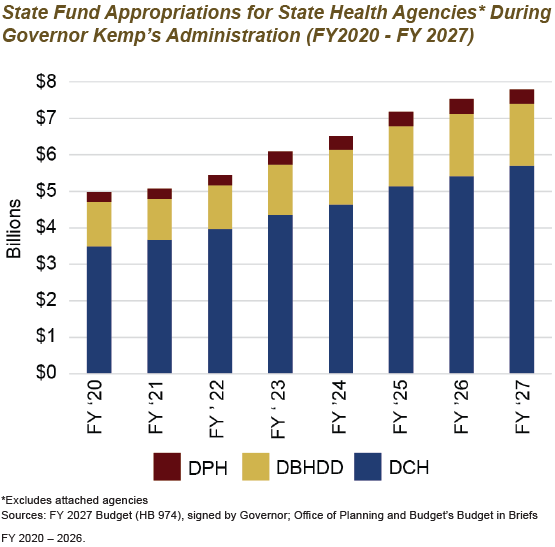
Under Gov. Kemp’s administration, total state fund appropriations dedicated to the state’s three primary health agencies have grown from almost $5 billion in FY 2020 to about $7.8 billion in FY 2027 (excluding their administratively attached agencies). Since FY 2020, state funds increased by 63% or an average of about $315.6 million per year at Department of Community Health (DCH); by 38% or an average of about $66.8 million per year at Department of Behavioral Health and Developmental Disabilities; and by 45% or an average of about $17.5 million per year at Department of Public Health. Over the same eight-year period, inflation rose approximately 31%. Although all three agencies grew over the past eight years, about $7 in every $10 state dollars spent on Georgia’s three primary health agencies has consistently been allocated to the Department of Community Health.
Increased State Spending on Medicaid Over Past Eight State Budget Cycles Reflects National Trends
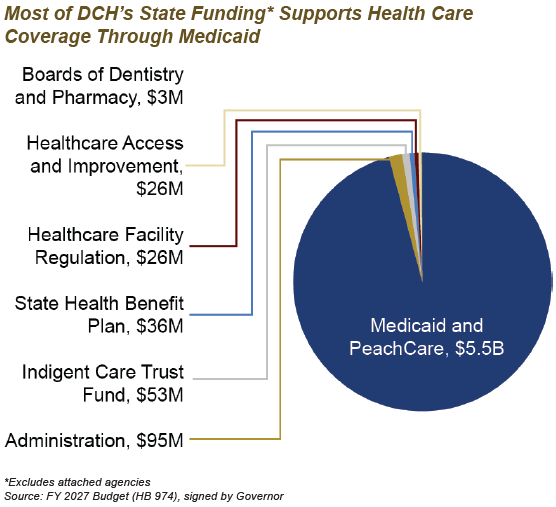
The Department of Community Health (DCH), specifically Medicaid, accounts for the majority of the total state health spending increase over the past eight years. From FY 2020 to FY 2027, total state funds allocated to Medicaid and PeachCare grew from $3.4 billion to $5.5 billion. Overall, Medicaid is a cost-effective program and costs typically grow at a slower rate than both Medicare and private insurance. Much of the substantial growth in state Medicaid spending over the past eight years is reflective of external factors experienced across states rather than significant new investments unique to Georgia.
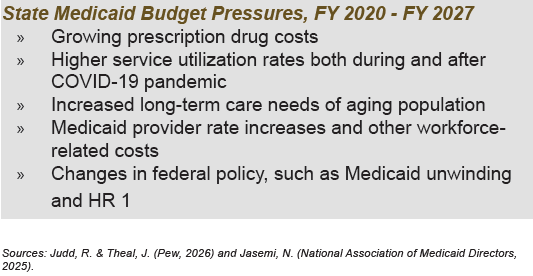
For example, DCH’s largest year-to-year state funding increase between FY 2020 andFY2027 occurred in FY 2025. That growth was driven in large part by a combination of 1) Medicaid provider rate increases, 2) skilled nursing facility costs and 3) the expiration of pandemic-era federal funds (after the pandemic-era enhanced federal Medicaid match for continuous eligibility fully expired in December 2023 and the state resumed paying about 34% of Medicaid health care benefit costs in January 2024).
Despite Increased State Health Spending, Health Care Access and Outcomes Have Remained Relatively Stagnant Over Time
During Gov. Kemp’s administration, state elected officials have supported critical state investments across all three health agencies. For example, in FY 2023 alone, state funding increases resulted in the:
- Launch of Georgia’s home visiting program for pregnant people and their infants
- Implementation of express lane eligibility for Medicaid-eligible children and extension of postpartum Medicaid coverage from six months to one year
- $5,000 cost-of-living increases for full-time state agency staff, along with salary increases for hard-to-fill job categories like psychiatric hospital nurses and environmental health specialists
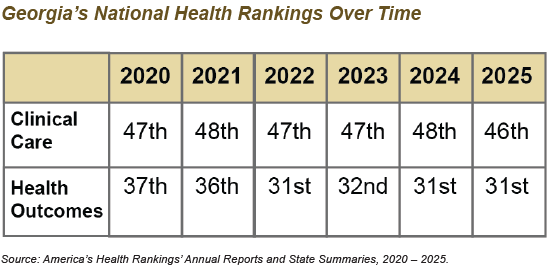
Even with these important state health budget increases, Georgia continues to rank near the bottom nationally in clinical care measures related to access and quality of care and the uptake of preventive services. For example, in 2025, 16.4% of adults in Georgia avoided care due to costs (compared to 11.5% national average). Georgia has seen modest improvements in health outcome measures related to behavioral health, mortality and physical health, but continues to rank in the bottom half of states. For example, in 2025, 10.2% of babies in Georgia were born with low birth weight (compared to 8.6% national average).
Health Priorities Impacted by Governor’s FY 2027 Budget Disregards
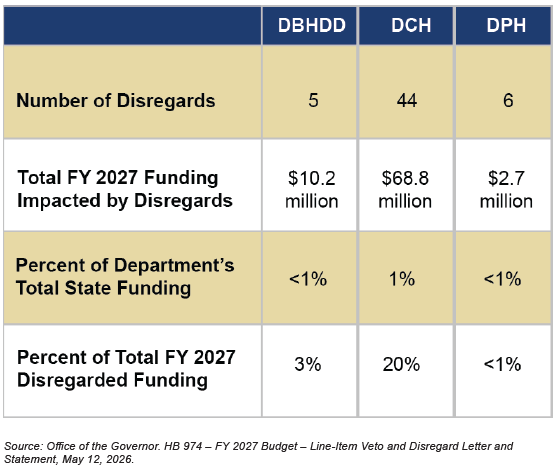
To partially offset the cost of more than $1.2 billion in income tax cuts approved through HB 463 (2026 Session), the Governor is directing state health agencies to disregard about $81.8 million in state funds. The disregards represent a small proportion of each Department’s total state funds but leave growing health challenges, like the high demand for home- and community-based services for Georgians with intellectual and developmental disabilities, to linger until the next budget cycle.
Significant budget disregards include:
- $48.4 million to support reimbursement rate increases for Medicaid providers and facilities
- $9.7 million to address the physician workforce shortage
- $9.6 million for 400 new home- and community-based waiver slots under NOW/COMP as well as support for program administration
- $4 million to develop and implement a rural hospital solvency evaluation plan
Department of Community Health
The Department of Community Health (DCH) administers the state’s health care safety net, reimburses hospitals for services provided to uninsured and underinsured Georgians, manages health insurance coverage for state and school system employees and regulates health and long-term care facilities. The FY 2027 budget provides the Department with $5.8 billion in state funds (including attached agencies). That amount includes $5 billion in state general funds, $679 million in a combination of ambulance, nursing home and hospital provider fees, and $124 million in tobacco settlement funds. Overall, about 93% of the Department’s total state funds are earmarked for Medicaid and PeachCare. The budget increases the Department’s state funding by $291 million, or 5%, above the original FY 2026 budget.
Medicaid and PeachCare
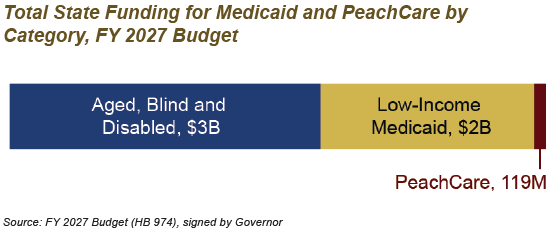
Medicaid and PeachCare provide affordable health insurance to about 1.8 million Georgians with lower incomes. PeachCare covers children from families with incomes above the Medicaid threshold. Low-income Medicaid covers children, pregnant/postpartum people, parents with very low incomes and adults who qualify under the Pathways to Coverage program. The Aged, Blind, and Disabled program covers older adults and individuals with disabilities and accounts for more than half (58%) of total FY 2027 state funds for Medicaid and PeachCare.
Between July 2024, when post-pandemic Medicaid redeterminations ended, and December 2025, child enrollment in Medicaid and PeachCare declined by about 8%.[1] That downward trend is forecasted to continue as evidenced by the FY 2027 reduction in base funding to account for projected enrollment decreases in Low-income Medicaid (of which a majority of enrollees are children) and PeachCare. The explanations behind Georgia’s concerning child enrollment declines are not yet fully understood.
Health Care Access and Affordability Remain a Challenge
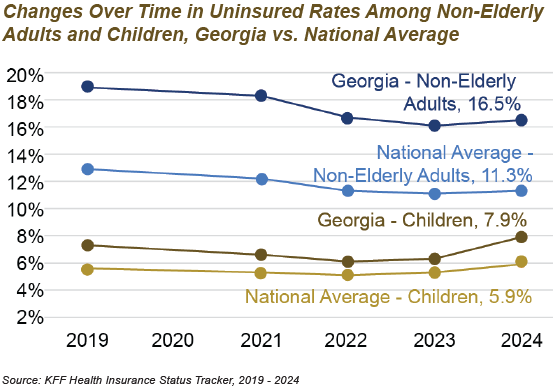
Access to affordable, high-quality health care remains a struggle for many Georgians. The percentage of Georgians with health insurance increased from 2021 to 2023 thanks in part to pandemic-era federal policies, such as continuous enrollment for people covered by Medicaid and enhanced premium tax credits for people who qualified for private health plans through the marketplace. However, more recent data indicate that uninsured rates among both non-elderly adults and children are rising, and the state has the 2nd highest uninsured rate in the nation.[2]
In July 2023, Georgia launched the Pathways to Coverage program, which offers a Medicaid option for low-income adults who can report work, higher education or some other combination of qualifying activities for 80 hours per month. As of March 2026, Georgia had invested over $30.9 million in state funds (about $146.9 million in total state and federal funds) in that program yet only had about 16,000 Georgians actively enrolled.[3]
Budget Largely Fails to Address Health Care Changes Under Recent Federal Law
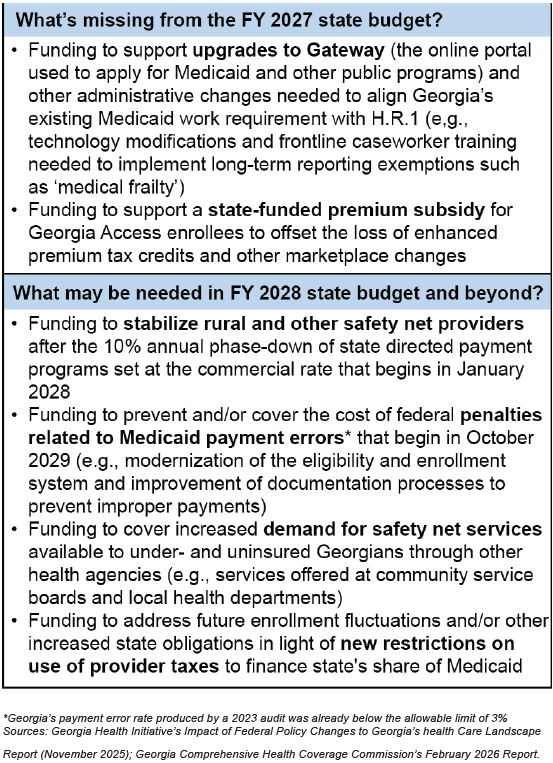
Over the next decade, H.R. 1 and related federal funding and policy changes will drastically alter which Georgians are eligible for and/or can afford Medicaid and Georgia Access coverage. These changes will also alter how the state can adequately compensate health care providers serving Medicaid patients and finance state Medicaid costs. Without federal or state action, these policy changes will mean more uninsured Georgians, more rural and safety net hospitals at risk of service reductions or closures and greater demands on Georgia’s state health care budget. Preliminary data indicate that over half a million Georgians enrolled in marketplace plans through Georgia Access dropped their coverage during the 2026 open enrollment period.[4]
Over the next five years, Georgia could receive about $1 billion in total new federal funding from the Rural Health Transformation Program (RHTP) that was also authorized by H.R. 1. Georgia will use most of these funds to prepare the state’s rural health ecosystem to transition from a fee-for-service model to a value-based care model, which is intended to improve outcomes while controlling costs. Among other initiatives, the new federal funds will also support emergency preparedness for rural health facilities, telehealth enhancements and medical workforce supports.
These RHTP initiatives and funding do not address Georgia’s already high and growing uninsured rate among those who make low incomes, including the disproportionately high uninsured rates in rural counties. They also do not fully offset the estimated $1.5 to $5.4 billion loss in federal provider payments to Georgia’s hospitals and other providers due to changes to Medicaid state directed payment programs over the next decade.[5],[6] Rural hospitals already face unique financial challenges that result in lower operating margins; the potential for higher uncompensated care costs due to increases in the uninsured population, combined with reductions in supplementary federal provider payments, could create unsustainable financial pressure.
Addressing State-Level Budget Impacts of New Federal Health Care Policy
Department of Behavioral Health and Developmental Disabilities
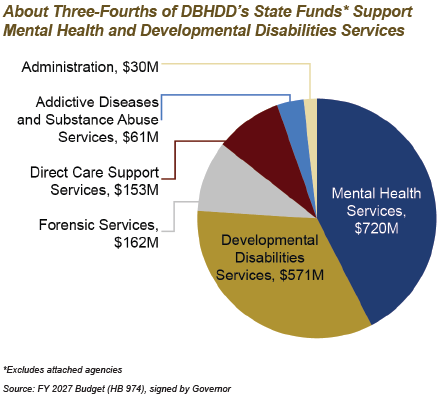
The Department of Behavioral Health and Developmental Disabilities (DBHDD) provides services primarily for uninsured and underinsured Georgians living with mental health conditions, substance use disorders and developmental disabilities. It operates state psychiatric hospitals and provides community-based services through contracted providers. The Department also operates forensic evaluation and treatment programs for individuals under the court system’s jurisdiction. The FY 2027 budget provides the Department with $1.7 billion in state funds (including attached agencies). That amount includes almost $1.7 billion in state general funds, $10 million in tobacco settlement funds and $4 million in opioid settlement funds.
The FY 2027 budget decreases the Department’s state funding by about $11 million, or almost 1%, below the original FY 2026 budget. Much of this decrease is accounted for by the reduction in the employer contribution rate for the State Health Benefit Plan and does not impact core services for Georgians.
Budget Reflects Increases for Supportive Housing and Home- and Community-based Services but High Needs Remain
After a lawsuit found that individuals with mental illness and developmental disabilities were unlawfully segregated from society and held in the state’s psychiatric hospitals, Georgia entered into a settlement agreement with the federal government in 2010. The Department of Behavioral Health and Developmental Disabilities’ FY27 budget includes increases that are aligned with the settlement agreement goals around expanding access to community-based services:
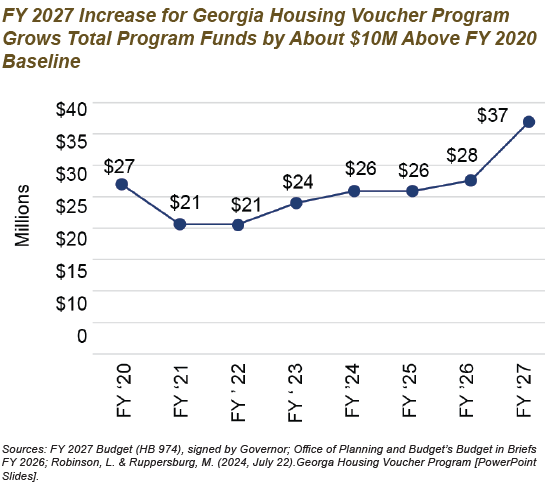
- About $9.3 million in state funds for 404 additional vouchers for the Georgia Housing Voucher Program, which provides housing and supports for Georgians with serious mental illness who are struggling to maintain housing
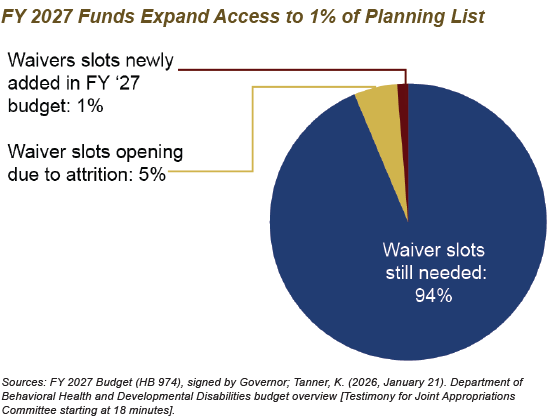
- About $2.3 million in state funds to add 100 New Options Waiver (NOW) and Comprehensive Supports Waiver Program (COMP) slots, which provide home- and community-based services for Georgians with intellectual and developmental disabilities
In February 2026, a federal ruling released Georgia from the behavioral health provisions of the 2010 settlement agreement due in part to the increase in housing voucher slots. The state may also pursue action to exit the intellectual and developmental disabilities provisions.
Even with the FY 2027 budget increases, access to community-based services falls short of Georgians’ needs, preventing the state from reaping the economic benefits. Transitioning from reliance on nursing homes and institutional settings to home- and community-based care results in long-term state cost savings and improves health outcomes. However, the 100 new NOW/COMP slots combined with the 400 slots opening due to attrition represent just 6% of the almost 8,000-person planning list. Similarly, supportive housing produces cost savings by relieving pressure on hospitals and jails, improving child welfare outcomes and allowing struggling Georgians to gain stable housing. Yet, the 404 additional vouchers for the Georgia Housing Voucher program are a mere fraction of the 9,000 supportive housing vouchers required by the original settlement agreement provisions.
Department of Public Health
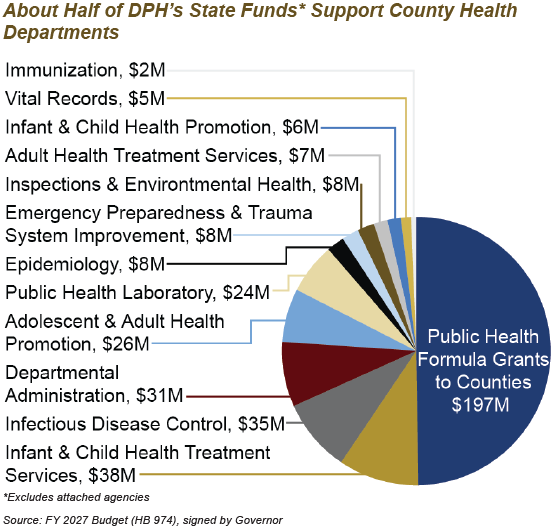
The Department of Public Health (DPH) operates programs focused on disease and injury prevention, health promotion and health-related disaster response and preparedness. The FY 2027 budget provides the Department with about $429 million in state funds (including attached agencies). That amount includes $396 million in state general funds, almost $14 million in tobacco settlement funds and almost $19 million in relevant trust funds for attached agencies.
The budget decreases the Department’s state funding by about $6 million, or 1.5%, below the original FY 2026 budget. Much of this decrease is accounted for by the reduction in the employer contribution rate for the State Health Benefit Plan and does not impact core services and functions for Georgians. One notable FY 2027 budget change is a $3.7 million increase to expand the home visiting program into 33 more counties, allowing the program to serve families in a total of 103 rural counties.
Endnotes
[1] GBPI analysis of July 2024 and December 2025 state Medicaid and CHIP child enrollment data from data.medicaid.gov
[2] Carter, C. (2025). Health insurance coverage by state: 2023 and 2024. Department of Commerce’s United States Census Bureau. https://www2.census.gov/library/publications/2025/demo/acsbr-024.pdf.
[3] GBPI analysis of Georgia’s quarterly Medicaid expenditure reports and Pathways to Coverage active enrollment data as of March 31, 2026 received through open records requests to Department of Community Health
[4] Hart, A. (2026, April 20). Georgia’s ACA enrollment plunges, raising concerns for rural hospitals. Georgia Recorder. https://georgiarecorder.com/2026/04/20/georgias-aca-enrollment-plunges-raising-concerns-for-rural-hospitals/
[5] Department of Community Health (2026). Comprehensive health coverage commission: February 2026 report. https://dch.georgia.gov/document/document/chccfeb2026report/download
[6] Georgia Health Initiative. (2025). Impact of federal policy changes to Georgia’s health care landscape. https://georgiahealthinitiative.org/wp-content/uploads/2025/11/Impact-of-Federal-Policy-Changes-to-Georgias-Health-Care-Landscape_Report_November_2025.pdf