View more sections of the 2027 budget primer here.

How Does Georgia Raise Revenue?
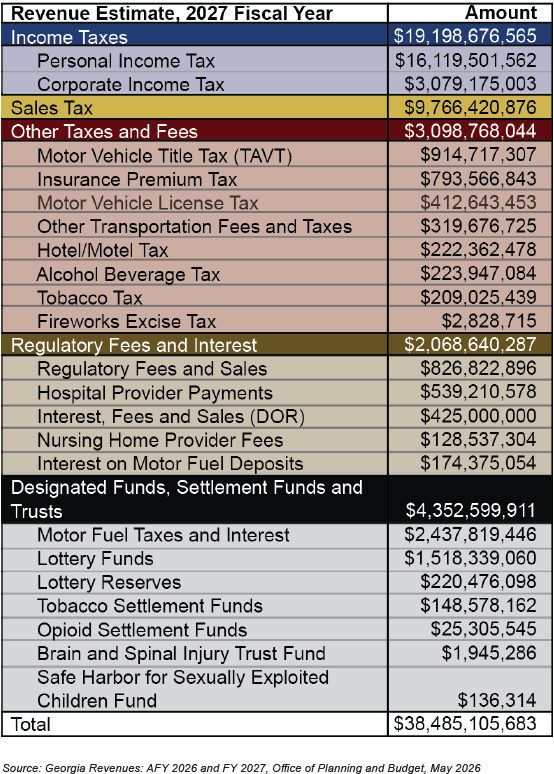
Georgia’s $38.5 billion state budget for Fiscal Year (FY) 2027 is primarily funded by personal and corporate income taxes (50%), in addition to sales taxes (25%), motor fuel taxes (6%) and a variety of other levies and fees. Since 1982, Georgia’s income tax has served as the state’s largest source of revenue, enabling Georgia’s budget to keep pace with the needs of a growing state that will add approximately 820,000 residents (+8%) between fiscal years 2020 and 2027.
Income taxes help balance the regressive effects of sales taxes and fees by allowing the state to collect a proportionate share of taxes from the wealthiest earners and most profitable corporations. A healthy income tax is also less sensitive to economic downturns, which can lead to sharper declines in sales tax revenues.
Regressive taxes push lower and middle-income residents to pay a greater share of their earnings in taxes compared to higher income individuals and corporations who pay a lower share of what they make overall. For example, when families shop for daily necessities such as clothing or toiletries, those with lower incomes end up paying a higher share of their wages in sales taxes for these products than higher income families. Income taxes help to even this out by ensuring that those at the higher end of the economic ladder are assessed at least some state taxes on income that is otherwise likely to go untaxed in Georgia.
Taxing income helps to balance the regressive effects of sales taxes on consumption, ensuring that those at different income levels pay a comparable share of their earnings to support state programs and services. This also helps to avoid holding back households making low-to-middle incomes by keeping the share of their income paid in taxes proportionate to the share paid by corporations and high earners.
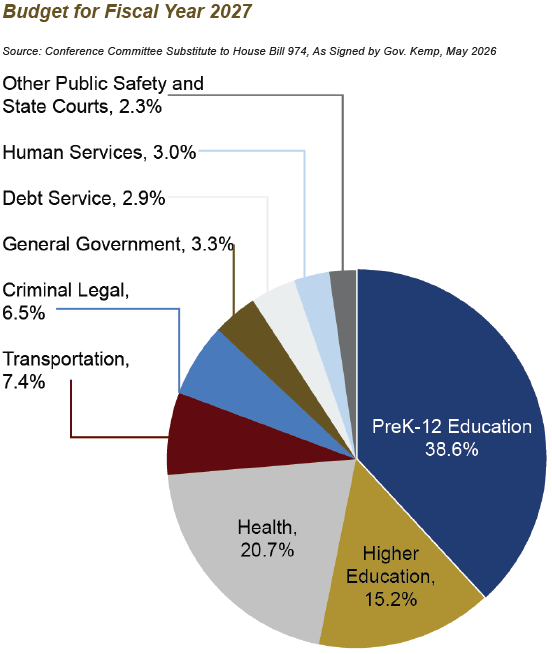
Income Tax Raises Half of All State Revenue
Georgia’s governor holds unilateral authority to set the state’s revenue estimate, which effectively acts to cap spending as the General Assembly is restricted from budgeting above this amount. Gov. Kemp’s FY 2027 revenue estimate is set at $38.5 billion. The General Assembly is solely responsible for appropriating these funds and deciding how Georgia’s public funds are spent. However, the governor is authorized to issue line-item vetoes and to instruct state agencies to “disregard” funding instructions if revenue projections change.
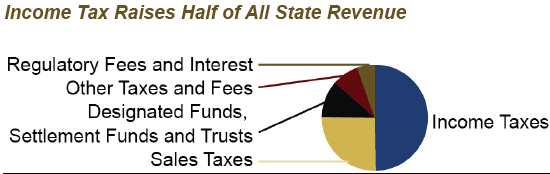
Major Funding Categories
Each year, the General Assembly passes two budgets, one for the amended fiscal year, which adjusts funding levels based on enrollment fluctuations and state revenue collections, and a full budget for the upcoming fiscal year, which begins on July 1 and ends on June 30. In FY 2027, Georgia plans to spend $76.6 billion.
Most of the budget comes from $38.5 billion in state revenues, including $32.9 billion in General Funds that can be freely appropriated, $2.4 billion in Motor Fuel funds, $1.7 billion in Lottery funds, and $1.5 billion in regulatory fees, settlement funds and other revenues.
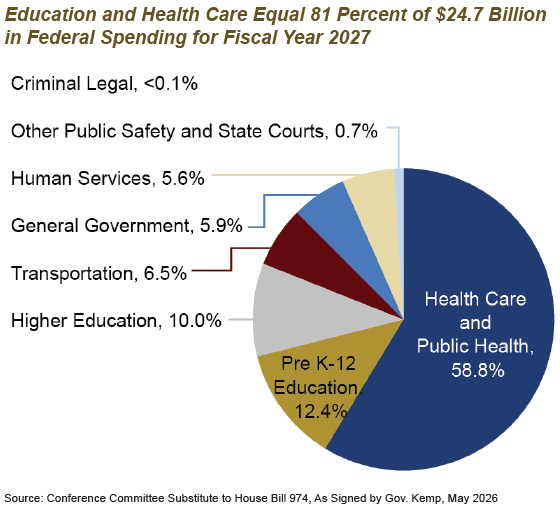
Georgia’s budget also includes an estimated $24.7 billion in federal funds and grants, which help to cover the costs of programs such as Medicaid. For the most part, these funds are reserved for specific purposes and guided by federal eligibility and enrollment criteria.
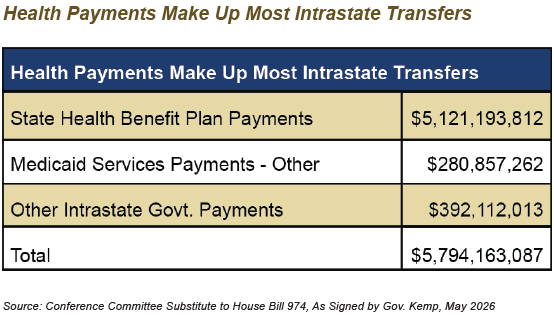
This year, Georgia’s budget includes $7.6 billion in agency funds raised primarily through tuition for higher education institutions. Finally, intrastate government transfers comprise $5.8 billion in state spending, which are largely directed to the State Health Benefit Plan to insure state employees and educators.
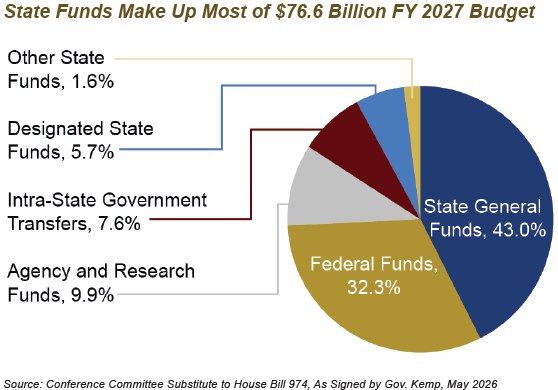
General Fund: $32.9 Billion (43% of Georgia’s Budget)
Georgia’s General Fund is generated mostly through income taxes on personal and corporate earnings and sales taxes on consumer transactions. The state also assesses excise taxes, or user fees, on tobacco, alcohol and fireworks, along with a variety of other taxes and fees.
The state-funded portions of education, Medicaid and most other state services are primarily paid through the General Fund. Remaining General Fund appropriations are directed to state agencies and functions of government such as human services, law enforcement and the criminal legal system. Not included are dedicated taxes and fees that are collected into other funds such as those raised by the Lottery and Motor Fuel taxes.
Federal Funds: $24.7 Billion (32% of Georgia’s Budget)
Most of Georgia’s overall public spending for health care, in addition to a significant share of funding for K-12 education, transportation and other services is paid for with $24.7 billion in federal funds. These federal funds are largely based on enrollment in benefit programs jointly administered by Georgia and the federal government.
Federal rules require the state to pay a share of the cost for Medicaid, the Supplemental Nutrition Assistance Program (SNAP) and other programs and services that benefit Georgians. Recent changes to federal eligibility criteria for public benefit programs, including Medicaid and SNAP, will continue to affect the state budget by changing the costs the state is responsible for and the availability of these programs and services for state residents. In FY 2027, Georgia will also pay an additional $46.4 million in state funds for SNAP program administration due to the federal government scaling back their funding commitment from 50% to 25% of costs in FY 2027.
Agency and Research Funds: $7.6 Billion (10% of Georgia’s Budget)
The $7.6 billion in agency and research funds includes University System of Georgia revenues, in addition to tuition and fees raised by public higher education institutions. It also includes regulatory fees and revenue raised directly by other individual state agencies.
Motor Fuel Funds: $2.6 Billion (3% of Georgia’s Budget)
Revenues raised from the state’s motor fuel taxes are required to be spent on infrastructure and transportation under the state constitution. The money is dedicated to a mix of new construction, maintenance of existing roads and bridges and debt service on past projects. Georgia’s 2026 motor fuel rates are 33.3 cents on gasoline and 37.3 cents on diesel, a slight uptick from last year. When the gas tax is suspended, as approved by the General Assembly for 60-days during the 2026 legislative session and extended for an additional two weeks by executive order, surplus funds are used to backfill lost motor fuel tax collections to preserve needed funding for infrastructure.
Lottery Funds: $1.7 Billion (2% of Georgia’s Budget)
The $1.5 billion in Lottery revenue estimated to be raised in FY 2027, along with $220 million released from Georgia’s undesignated Lottery reserve, is constitutionally designated for Georgia’s pre-kindergarten (pre-K) program and scholarships for higher education. Currently, Georgia maintains $2.5 billion in the state’s designated Lottery surplus account, with $1.7 billion of those funds unrestricted and available for appropriation. Under state law, Georgia’s Lottery Reserve must release at least 10 percent of excess reserve funds annually to be appropriated for educational programs.
Settlement Funds: $174 Million (0.2% of Georgia’s Budget)
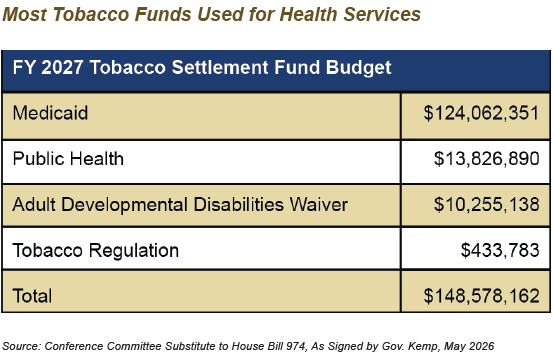
Tobacco Settlement Funds
Georgia receives annual payments in perpetuity from the settlement agreement signed in 1998 with four of the nation’s largest tobacco companies, known as the Tobacco Master Settlement Agreement. Georgia is not required to dedicate these payments for specific purposes. As a result, the use of tobacco settlement money can vary from year to year, with most of the funds allocated to health care rather than smoking cessation or health costs directly related to tobacco use.
Opioid Settlement Funds
In 2022, Georgia joined other state and local governments in litigation against the three largest pharmaceutical distributors and agreed on an 18-year settlement plan that will direct $636 million to the state. FY 2027 is the first year that these funds are incorporated into the state budget with $25.3 million appropriated across three state agencies, including the Department of Behavioral Health and Developmental Disabilities (DBHDD), Corrections (DOC) and the Georgia Bureau of Investigation (GBI). These funds will cover part of the cost of adult addictive disease services, state prisons and grants for accountability courts and medication assisted treatment facilities.
Intrastate Transfers: $5.8 Billion (8% of Georgia’s Budget)
Intrastate transfers involve funds being moved from one area of government to another and primarily include payments from the State Health Benefit Plan (SHBP), which insures about 660,000 state employees, school system employees, retirees and their families. This year, the state made a change to how different types of employees pay into SHBP, raising the employer contribution for educators and lowering it for other state workers. This structural change was driven by several factors, including an aging member population, flat subscriber levels and decisions made by state policymakers since the Great Recession to shift most health care costs for classified staff on to school districts.
State agencies will save $241.7 million by paying less per employee, with the contribution rate decreasing from 29.5% to 20.3%. This change is partially offset through an increase in the rate assessed to school employees, which will increase by 2.7% or $600 per employee annually at a state cost of $69.8 million. Local schools will share the cost of funding this change for approximately 67,200 district employees at an estimated cost of $40.3 million next year.The state also made an additional direct appropriation of $31.6 million to help shore up the plan’s solvency.