

Introduction
The Department of Early Care and Learning (DECAL) administers: Child Care and Parent Services (CAPS); the Georgia Pre-Kindergarten Program; Nutrition Services, which directs the federal Child and Adult Care Food Program; the Summer Meals program for low-income children in daycare facilities; and Quality Initiatives, which works to improve the quality and accessibility of child care programs.
State general funds support CAPS, and state lottery funds support the pre-K program. The other DECAL programs are supported entirely by federal funds.
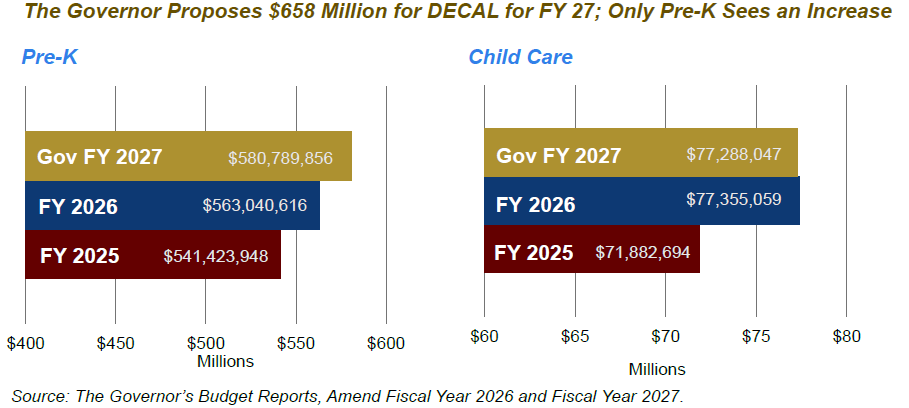
Governor Kemp proposed sending $659 million to DECAL in his Amended Fiscal Year 2026 budget and $658 million in his Fiscal Year (FY) 2027 budget. This would be a 3% increase between FY 2026 and FY 2027.[1] All the increases proposed by the governor are for pre-K.
Budget Highlights for DECAL
Amended Fiscal Year 2026 Budget
- $18.8 million increase to provide one-time $2,000 salary increases for all full-time DECAL staff and pre-K teachers and assistant teachers
- The majority of this increase, $17.2 million, will go to pre-K teachers and assistant teachers.
Fiscal Year 2027 Budget
- $12 million increase for year three of a four-year phase in to reduce the maximum pre-K class size from 22 to 20.
- $5.9 million to reflect an 8% increase in the employer contribution for pre-K teachers’ State Health Benefit Plan.[2]
The Governor’s Pre-K Proposal Would Continue Progress from the Past Two Years; CAPS lags behind
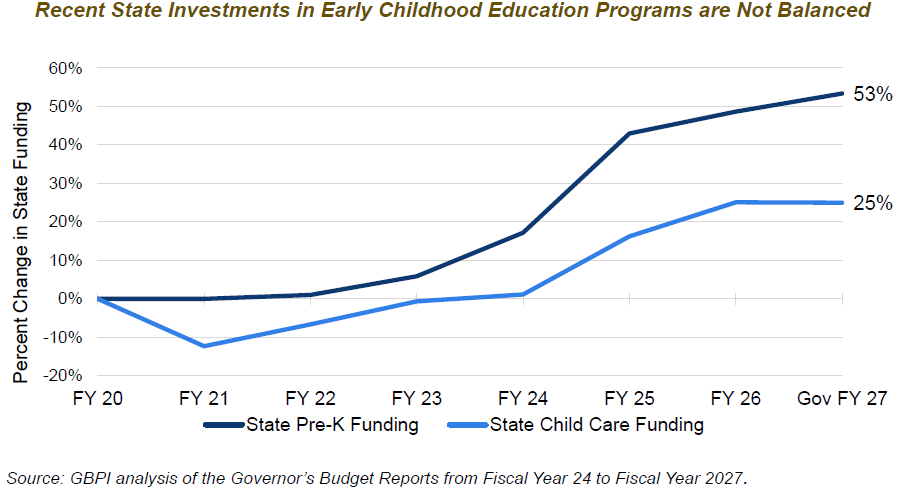
Two years ago, in FY 2025, state leaders provided almost $100 million in additional funding for the pre-K program. That recurring increase went to funding pay increases for pre-K lead and assistant teachers to make their pay more comparable to their K-12 counterparts, reducing class sizes, providing start-up and operational grants and improving student transportation. This year the governor proposes $12 million in new funding to continue year three of the four-year phase in to reduce class sizes from 22 to 20. If approved by the legislature, these proposals will continue to strengthen the state’s pre-K program.
While additional funding for pre-K continues to bolster the program, funding for CAPS remains woefully inadequate. Even with federal funding from the Child Care Development Fund, Georgia’s child care system reached only about 18% of families who were eligible in 2020.[3] This year, the governor proposed flat funding for CAPS for FY 2027. However, the state lost more than $170 million in federal relief funding in September 2024. That additional federal funding temporarily strengthened the program in new ways by providing an additional 22,000 CAPS scholarships and enhancements to support providers.[4] DECAL has since rolled back those expansions and unlike other states, Georgia did not make a major state investment in child care to preserve those significant gains.
Georgia, and the United States as a whole, have long underfunded the child care system. The care of young children has historically been seen as women’s work and is often invisible.[5] In Georgia and other Southern states, it’s been Black women’s work outside the home since the end of enslavement.[6] It is uncoincidentally one of the lowest-paid professions in the state and country.[7] Time and time again government has failed to see child care’s critical role to families and the economy.[8] Mothers often cannot work as much as they want or pursue better jobs because of lack of affordable and adequate child care arrangements.
Quality child care is unaffordable for the typical family in most Georgia counties, but it is a greater expense for Black and Latinx families.[9] Meanwhile, the state economy loses at least $2.52 billion annually due to child care challenges, like securing affordable care, and the state loses an estimated $105 million in tax revenue.[10]
This legislative session, lawmakers could do more to support child care providers, families and the economy through significant public investment in the child care system. For example, the governor proposed spending $325 million from the undesignated reserve to create an endowment for need-based scholarships to post-secondary students. Similarly, state leaders can use undesignated surplus funds to establish a child care trust fund to provide additional on-going support for child care.[11] Other states like New Mexico and Montana have created trust fund to bolster the child care systems.[12] Each state allows these funds to be used for child care affordability efforts, initiatives to improve quality and teachers’ workforce development. A trust fund could be an important mechanism to balance Georgia’s investment our early childhood education system.
Endnotes
[1] Office of Planning and Budget. (2026, January). The Governor’s Budget Report, AFY 2026 and FY 2027, Governor Brian P. Kemp; House Bill 973, as passed by the House.
[2] Ibid.
[3] Analysis completed by the Center for Law and Social Policy for GBPI.
[4] In an average year, DECAL typically serves about 50,000 children in a given week. Using federal relief dollars, the agency temporarily boosted the number of children receiving CAPS scholarships to about 72,000 a week.
DECAL’s August 2024 presentation to the Board of Early Care and Learning. https://www.decal.ga.gov/documents/BoardMeetings/2024-08-22_Board_Presentation.pdf.
[5] Lloyd, C.M. , Carlson, J., Barnett, H., Shaw, S., and Logan, D. (2021, September). Mary Pauper: A historical exploration of early care and education compensation, policy, and solutions. Child Trends. https://earlyedcollaborative.org/what-we-do/mary-pauper/.
[6] Ibid.
[7] Ibid.Gov Budget_2027_Pre-K_Child_Care
[8] Vogtman, J. (2017). Undervalued. A brief history of women’s care work and child care policy in the United States. National Women’s Law Center. https://nwlc.org/resource/undervalued-a-brief-history-of-womens-care-work-and-child-care-policy-in-the-united-states/.
Sethi, S. Johnson-Staub, C., Gallagher Robbins, K. (2020, July). An anti-racist approach to supporting child care through covid-19 and beyond. CLASP. https://www.clasp.org/publications/report/brief/anti-racist-approach-supporting-child-care-through-covid-19-and-beyond/.
[9] Finch Floyd, I. (2024, May 21). From barriers to bridges: Expanding access to child care and improving upward mobility for Georgia’s child care workers. Georgia Budget and Policy Institute. https://gbpi.org/from-barriers-to-bridges-expanding-access-to-child-care-and-improving-upward-mobility-for-georgias-child-care-workers/.
[10] Goldberg, H., Cairl, T. and Cunningham, T. (2025). For lack of care: The economic impact of child care challenges. Georgia Early Education Alliance for Ready Students and the Metro Atlanta Chamber. https://geears.org/wp-content/uploads/Opps-Lost-3.0.pdf.
[11] For more information on how Georgia could use surplus funds to establish a child care trust fund, see our report: From Barriers to Bridges: Expanding Access to Child Care and Improving Upward Mobility for Georgia’s Child Care Workers. https://gbpi.org/from-barriers-to-bridges-expanding-access-to-child-care-and-improving-upward-mobility-for-georgias-child-care-workers
[12] Office of the Governor. (2020, February 18). Governor creates early childhood trust fund. https://www.governor.state.nm.us/2020/02/18/governor-creates-early-childhood-trust-fund/.
Montana Department of Public Health and Human Services. (2025). Montana early childhood account. https://dphhs.mt.gov/boardscouncils/MontanaEarlyChildhoodAccount
