
Introduction
Georgia’s higher education system is administered through the University System of Georgia (USG) and the Technical College System of Georgia (TCSG), in addition to the Georgia Student Finance Commission (GSFC), which is responsible for state financial aid programs. Governor Kemp’s $5.9 billion FY 2027 budget for post-secondary education includes $373 million in new funding (+6.3%) above the current FY 2026 budget.[1]
Gov. Kemp’s executive budget proposals for Amended Fiscal Year (AFY) 2026 and (Fiscal Year) FY 2027 include several notable highlights that will significantly impact post-secondary education in Georgia. At the top of this list is a watershed investment in need-based financial aid. In the AFY 2026 budget, Kemp has proposed $325 million in state general funds to endow the Dedicating Resources to Educationally Advance More Students (DREAMS) Scholarship Program. While the House-passed AFY 2026 Budget appropriates $300 million for the DREAM Scholarship endowment, it eliminates $25 million previously designated by Gov. Kemp for scholarships after House lawmakers requested more information on how scholarships would be distributed.[2]
The AFY 2026 budget proposes $119.4 million for one-time pay increases of $2,000 for all full-time state employees across USG, TCSG and GSFC. With enrollment up by 4.8% for USG and 7.1% for TCSG, the FY 2027 budget also includes an increase of $250.1 million for enrollment and $58 million in additional Lottery funds for HOPE scholarships and grants.
In the FY 2027 budget, Governor Brian Kemp’s proposes:
- $270.2 million increase for the Board of Regents of the University System of Georgia for a total of $3.9 billion
- $8.4 million increase for the Technical College System of Georgia for a total of $547 million
- $94 million increase ($35.4 million in general funds and $58.6 million in Lottery funds) for Georgia Student Finance Commission for a total of $1.5 billion, including $1.2 billion in Lottery funds
University System of Georgia
Georgia’s four-year public higher education system, the University System of Georgia (USG), is composed of 26 higher education institutions located across the state. USG also encompasses the Georgia Public Library Service, which manages 61 libraries; and the Georgia Archives, which collects and preserves records and information about Georgia.
Amended Fiscal Year 2026 Proposed Changes
- $300 million increase for the DREAMS Scholarship Program, creating a state need-based aid scholarship program
- $105.2 million increase to provide one-time $2,000 salary increases for full-time state USG employees
Fiscal Year (FY) 2027 Proposed Changes
Funding for the teaching portion of the USG operating budget is set to increase by $263 million to $3.6 billion in FY 2027. Annual allocations for USG support student instruction, maintenance, and other initiatives that promote student learning.
Major highlights include:
- $218.6 million increase for USG enrollment growth and an increase in campus square footage
- $35 million increase to reflect a cost increase for the employer’s share of health benefits for USG employees
- $4.5 million increase for Teachers Retirement System to reflect an increase in the employer contribution rate from 21.91% to 22.32%
- $3.7 million increase across other programs under the Board of Regents, including the Agricultural Experiment Station, Cooperative Extension Service and Public Libraries
Technical College System of Georgia
The Technical College System of Georgia (TCSG) governs 22 two-year post-secondary institutions that offer technical education, adult education and workforce development programs. TCSG encompasses over 88 campus locations across the state and more than 600 programs
The proposed 2027 budget for technical colleges is $547 million, an increase of $8.4 million from fiscal year 2026.
Amended Fiscal Year 2026 Proposed Changes
- $14 million increase to provide one-time $2,000 salary increases for full-time, regular state TCSG employees
FY 2027 Proposed Changes
- $34.1 million increase for TCSG enrollment growth and an increase in campus square footage
- $21.1 million decrease to reflect a reduction in the employer contribution rate for the State Health Benefit plan for TCSG employees
- $748,416 reduction due to 1.8% decrease in enrollment for high-cost Programs such as aviation, commercial truck driving and nursing
Georgia Student Finance Commission & Lottery-Funded Programs
Governor Brian Kemp’s proposed 2027 budget includes $1.74 billion for Georgia’s Lottery-funded pre-kindergarten (pre-K), HOPE (Helping Outstanding Pupils Educationally) and other financial aid programs. Approximately $1.16 billion is allocated for HOPE Scholarship, and $581 million is appropriated for pre-K education.
Amended Fiscal Year 2026 Proposals
- $18.4 million increase to meet the projected need for the Dual Enrollment program. The Dual Enrollment program allows high school students to pursue post-secondary courses at an approved public or private institution, while receiving high school and college credit
- $12.2 million increase to meet the projected need for the HOPE Scholarship program at USG and private institutions. HOPE Scholarships are for students seeking associate or bachelor’s degrees at four-year post-secondary institutions
- $86 million reduction for the newly created Promise Scholarship voucher program to meet projected need based on eligibility for the 2025-26 academic year
FY 2027 Proposals
- $58 million increase to meet the projected need for the HOPE Scholarship program at USG and private institutions
- $27.6 million increase to meet the projected need for the Dual Enrollment program
- No change for the HOPE Grant program at the Technical College System of Georgia. HOPE Grants include the HOPE/Zell Miller Grant for students enrolled in certain certificate and diploma programs at public two-year colleges
- $4 million increase for Tuition Equalization Grant Program, which encourages Georgia residents to attend eligible private colleges in Georgia by providing assistance for students who attend eligible private postsecondary institutions
- $2.5 million increase to establish the Georgia Foster Care Scholarship in accordance with SB 85 (2025 Session). The Scholarship provides up to $30,000 per year for eligible foster and former foster youth pursuing a college education after all other federal or state grants, scholarships or tuition waivers are applied
- $1 million increase for a total of $11 million for the College Completion Grants Program to support expanded grant eligibility for students at TCSG institutions
Shifting the Financial Aid Policy Landscape in Georgia: The DREAMS Scholarship Program
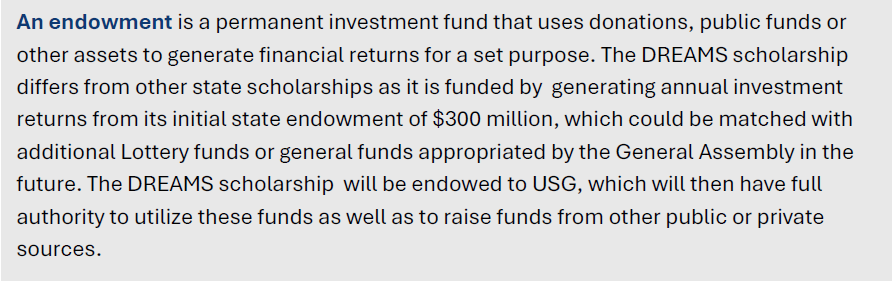
The DREAMS Scholarship Program was established in 2025 by the USG Foundation to serve students with unmet financial need in USG and TCSG.[3] In the 2026 State of the State address, Governor Kemp announced his plan to invest $325 million in the DREAMS Scholarship Program. As part of the AFY 2026 budget passed by the House, this appropriation was revised down to $300 million, eliminating $25 million in funds previously designated by Gov. Kemp for initial scholarships. Establishing a state funded need-based financial aid program is critical to providing all Georgians access to higher education programs that set them on a path to thrive.
Recommendations to Improve the DREAMS Scholarship
The creation of a need-based aid program is a long-awaited victory for all Georgians. To ensure that state resources are used to help the greatest number of students in an efficient and equitable way, lawmakers would be wise to create safeguards through legislation that accompanies funding allocated in the AFY 2026 budget. As a basic principle, students with the highest unmet need and the institutions that enroll the greatest number of low-income students should be prioritized.
- Do not mandate additional work hours beyond academic enrollment– Currently, the existing DREAMS Scholarship requires recipients to be employed at least part time in a paid or volunteer role.[4] This requirement is out of step with similarly structured aid programs and could significantly limit the reach of the DREAMS scholarship. The Pell Grant, the federal need-based financial aid program, does not require students to work as an eligibility requirement, nor does any state-sponsored need-based aid program in the nation. Georgia’s own HOPE Scholarship students are not required to work as an eligibility requirement. A work requirement for need-based financial aid recipients is unprecedented and could pose a threat to academic achievement.
- Increase scholarship funds using unrestricted Lottery reserves- Georgia’s education Lottery reserves total $2.5 billion, exceeding the amount required for the HOPE shortfall reserve ($796 million) by $1.7 billion.[5]
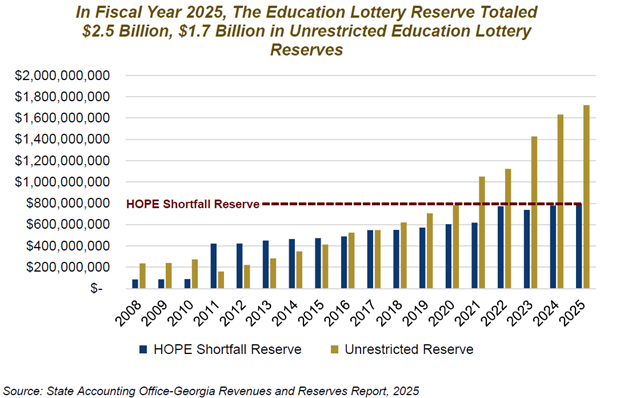
Recognizing this trend and the need to spend down excess reserves, lawmakers enacted legislation in 2025 (HB 353) requiring that 10% of the unrestricted Lottery reserves must be released annually and appropriated for “educational purposes and programs.”[6] Gov. Kemp’s revenue estimate for FY 2027 projects that $1.5 billion will be raised in new Lottery revenues and releases $220.5 million (13%) of the state’s $1.7 billion in undesignated Lottery reserves. However, in FY 2025 the state also generated $108.3 million in interest on its existing reserves, demonstrating that the balance of these funds continues to grow from both recurring Lottery revenues and interest payments.[7]
To fund the recurring cost of annual financial aid, Gov. Kemp’s plan for the DREAMS scholarship involves combining the initial state endowment of $300 million with substantial private funds expected to be raised through USG. Looking ahead, state leaders should set clear goals and expectations for annual award totals to ensure the program functions reliably and closes the gap in higher education costs for all eligible students. To this end, and as part of optimizing and scaling up the DREAMS Scholarship, lawmakers should consider utilizing funds available as part of the remaining $1.5 billion in unrestricted Lottery reserves to enable a greater number of students to receive need-based financial aid scholarships.
End Notes
[1] Office of Planning and Budget. (2026, January). The Governor’s Budget Report, AFY 2026 and FY 2027, Governor Brian P. Kemp.
[2] House Bill 973, as passed by the House.
[3] USG Foundation. (2025, Jan. 29). Scholarships and Reports. https://www.usgfoundation.org/scholarships_and_reports/dreams
[4] Ibid.
[5] Office of Planning and Budget. (2026, January). The Governor’s Budget Report, AFY 2026 and FY 2027, Governor Brian P. Kemp.
[6] House Bill 353, as signed by Gov. Kemp (2025).
[7] Georgia Accounting Office. (2025, October 15). State of Georgia revenues and reserves report fiscal year ended June 30, 2025. https://sao.georgia.gov/document/document/fy25grrrfinalv2101525-securedpdf/download