

Introduction
Among a range of duties, the Department of Community Health administers the state’s healthcare safety net, reimburses hospitals for services provided to uninsured and underinsured Georgians, manages health insurance coverage for state and school system employees and regulates health care and long-term care facilities. Governor Kemp’s budget proposal for Fiscal Year (FY) 2027 provides DCH with $5.8 billion in state funds.[1] That includes almost $5 billion in state general funds, $539.2 million in hospital provider payments, $128.5 million in nursing home provider fees, $124 million in tobacco settlement funds and $11.5 million in ambulance provider fees.[2] Governor Kemp’s budget proposal increases DCH’s state funding by $235.4 million, or 4%, above the original FY 2026 budget. Much of the state funding increase is accounted for by projected growth in Medicaid utilization among older adults and individuals with disabilities.
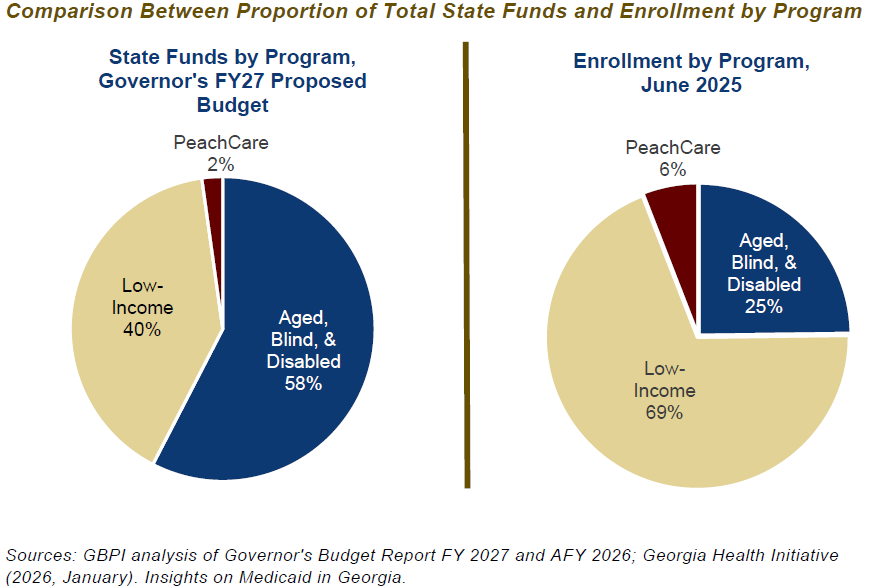
About 94% of DCH’s proposed funding is earmarked for Medicaid and PeachCare, which provides life-saving healthcare coverage to about 2 million Georgians with lower incomes. Aged, Blind and Disabled Medicaid covers older adults and individuals with disabilities; Low-Income Medicaid covers children, pregnant and postpartum people, parents/caregivers, and adults who can meet a work or other activity requirement; and PeachCare covers children in households with an income above the Medicaid threshold. Although older adults and individuals with disabilities account for just a quarter of total enrollees, over half of the proposed $5.5 billion in state funds flowing to the Medicaid and PeachCare programs in FY 2027 cover the care for that same population. They tend to have more complex needs and are more likely to require long-term care compared to other enrollees, which leads to higher health care costs.[3]
Proposed Budget Fails to Reduce Immediate or Long-Term Harm of Health Care Changes Under Recent Federal Law
Over the next decade, H.R. 1 and related federal changes will drastically alter which low-income Georgians are eligible for and/or can afford Medicaid and Georgia Access coverage and how the state can adequately compensate health care providers serving Medicaid patients. Without federal or state action, these policy changes will mean more uninsured Georgians, more rural and safety net hospitals at risk of service reductions or closures and more demands on Georgia’s state health care budget. Over the next five years, Georgia could receive up to $1 billion in new federal funding from the Rural Health Transformation Program (RHTP) that was also authorized by H.R. 1.[4] While these new federal funds will likely benefit rural health, the RHTP funding and initiatives neither address Georgia’s already high and growing low-income uninsured population nor offset the estimated $5.4 billion loss in federal provider payments to Georgia’s hospitals and other providers.
State Health Care Budget Pressures Created by Recent Federal Law
|
H.R. 1 Policy Change |
Potential State-Level Impact (2025 – 2034) |
Potential |
| Medicaid financing changes, including reduction of supplemental federal provider payments through state directed payment programs | Federal supplemental provider payments for Georgia hospitals and other providers estimated to decrease by $5.4 billion | Increased state funds may be needed to stabilize providers and ensure rural and safety hospitals remain financially solvent |
| Eligibility and coverage changes for Medicaid and Georgia Access enrollees (such as new eligibility restrictions for lawfully present immigrants) and expiration of enhanced premium tax credits for Georgia Access enrollees | 32,000 Medicaid enrollees and 460,000 Georgia Access enrollees estimated to lose health insurance
Uncompensated care costs from uninsured Georgians seeking care estimated to increase by $10.5 billion |
Increased state funds may be needed to address higher uncompensated care costs, particularly for rural and safety net providers, and heightened demand for safety net health services provided by DBHDD, DPH and other state agencies |
| Required alignment of Georgia’s existing Medicaid work and other qualifying activities requirement under the Pathways to Coverage program with new federal Medicaid work requirements | Modest Medicaid enrollment increases expected under less restrictive federal work and other activities requirement | Increased state funds may be needed to cover cost of technology changes to Georgia’s eligibility and enrollment system and for slightly higher Medicaid enrollment among low-income adults |
Source: Georgia Health Initiative (2025, November). Impact of Federal Policy Changes to Georgia’s health Care Landscape.
Budget Highlights
Amended Fiscal Year 2026 Budget
- $35 million increase (non-DCH line item) for the Department of Administrative Services’ Georgia Technology Authority to support modernization of Georgia’s integrated eligibility system, which is the technology system used to process eligibility and enrollment for Medicaid and other public benefits
- $1.7 million increase to provide one-time $2,000 salary increases for full-time DCH employees
- A no cost authorization to submit a waiver for federal approval to the Centers for Medicare and Medicaid Services to cover home- and community-based services for Georgians enrolled in the Therapeutic Care Model program, which is intended to serve high-need, Medicaid-enrolled children and youth and decrease use of residential treatment[5]
Fiscal Year 2027 Budget
- $4.5 million increase to support undergraduate and graduate medical education, including medical student capitation for 380 Georgians at the Philadelphia College of Osteopathic Medicine (located in Suwanee and Moultrie) and 105 new residency slots in primary care medicine
-
Changes related to the State Health Benefit plan
- A reduction across all agencies in the employer contribution rate from 29.54% to 20.264%
- $2.9 million decrease to reflect a reduction in the employer contribution rate for the State Health Benefit plan for DCH employees specifically
-
A no cost recognition in the DCH FY 27 proposed budget of a $207.5 million increase in Department of Education, Department of Early Care and Learning and Georgia Military College formula funds to reflect an 8% increase in the employer contribution per-member per-month rate for certified school employees and lead/assistant teachers
- School districts will also see similar increases in costs for non-certified employees such as custodians and bus drivers
- The increase addresses rising health care costs and accrued liability for school employee retiree health benefits
- A reduction across all agencies in the employer contribution rate from 29.54% to 20.264%
Endnotes
[1] Office of Planning and Budget. (2026, January). The Governor’s Budget Report, AFY 2026 and FY 2027, Governor Brian P. Kemp; House Bill 973, as passed by the House.
[2] Governor’s Office of Planning and Budget. (2026, January). The Governor’s Budget Report, AFY 2026 – FY 2027. https://opb.georgia.gov/budget-information/budget-documents/governors-budget-reports
[3] Euhus, R., Burns, A., & Rudowitz, R. (2025, February 7). 5 key facts about Medicaid eligibility for seniors and people with disabilities. KFF. https://www.kff.org/medicaid/5-key-facts-about-medicaid-eligibility-for-seniors-and-people-with-disabilities/
[4] Georgia Department of Community Health. Georgia’s application to the RHT program. https://dch.georgia.gov/georgias-application-rht-program
[5] Centers for Medicare and Medicaid Services. (2025, September 30). [Approval letter for Therapeutic Care Model state plan amendment]. https://medicaid.georgia.gov/document/document/ga-25-0007-therapeutic-care-model/download