
Introduction
The Department of Public Health’s (DPH) programs focus on health promotion and health-related disaster response and preparedness, as well as disease and injury prevention. Over 5,000 state and county public health workers fill a range of critical roles in their communities, from inspecting restaurants to prevent foodborne illness to providing vision and hearing, screening so children are prepared for school.
Governor Kemp’s budget proposal for Fiscal Year (FY) 2027 provides DPH about $423 million in state funds.[1] That includes $390.6 million in state general funds and about $13.8 million in tobacco settlement funds as well as about $18.6 million in combined Brain & Spinal Injury and Trauma Care Trust Funds for the attached agencies. Governor Kemp’s budget proposal decreases DPH’s state funding by about $12 million, or almost 3%, below the original FY 2026 budget. That decrease is largely driven by the reduction in the employer contribution rate for the State Health Benefit Plan; DPH’s core functions and services for Georgians are not impacted.
Increases in public health spending have been shown to reduce preventable deaths and save money; however, Georgia’s investment in public health remains low.[2] Of the almost $7.9 billion in state funds the Governor proposes sending to Georgia’s three primary state health agencies in FY 2027, only about 5% of those funds would be allocated to DPH.
Proposed FY 2027 Budget Reflects Expansion of Home Visiting and Consolidation of Public Health Lab Capacity
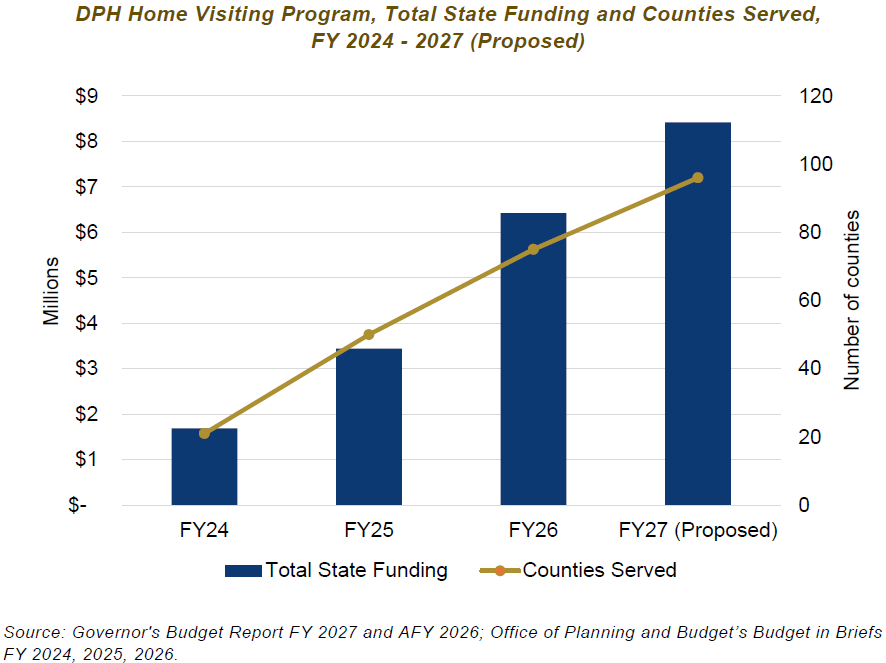
The proposed FY 2027 budget includes a $2 million increase to expand Georgia’s home visiting program that first launched in July 2023. Through this program, public health nurses and community health workers provide no cost, personalized care during and after pregnancy and to infants up to 1 year old in order to improve maternal and infant outcomes, particularly in rural counties with limited access to care and support.[3] The small proposed increase in state funds would allow the program to serve families in a total of 96 counties by leveraging $8.4 million in total state funds. The House’s Georgia Families First legislative initiative introduced in February 2026 goes beyond the Governor’s recommendation and would add $8.9M in FY27 state funds (for a cumulative total of $15.3M in state funds) to expand the program to 154 counties.[4]
The proposed budget also transfers about $24.9 million in existing laboratory funds into a new stand-alone ‘Georgia Public Health Laboratory’ funding category. DPH runs two state public health labs that provide clinical and environmental lab services and help monitor health threats ranging from dengue to anthrax. For example, the state public health lab in Decatur (DeKalb county) is currently the only lab in the state authorized to process the newborn screening specimens that are collected from all babies within the first few days of life. In FY 2025, it processed over 150,000 newborn screening specimens to identify serious but often treatable conditions that can affect a child’s life-long health and survival.[5] Consolidation of state public health lab funding into one funding category also reduces administrative burden when receiving new funds. For example, in December 2025, DPH was awarded an initial $2 million in federal funds through the Rural Health Transformation Program to expand capacity at the state public health lab in Waycross (Ware county).[6]
Budget Highlights
Amended Fiscal Year 2026 Budget
- $11.4 million increase to provide one-time $2,000 salary increases for full-time DPH employees
Fiscal Year 2027 Budget
- $24.9 million in existing funds re-allocated into a new line item for the Georgia Public Health Laboratory program
- $14.5 million decrease to reflect a reduction in the employer contribution rate for the State Health Benefit plan for DPH employees
- $2 million increase to expand the maternal and infant home visiting program to 21 additional counties
- $1.2 million increase (non-DPH line item) in general obligation bonds to fund improvements and renovations at the Georgia Public Health Laboratory and the Public Health District offices in Rome and Waycross
Endnotes
[1] Office of Planning and Budget. (2026, January). The Governor’s Budget Report, AFY 2026 and FY 2027, Governor Brian P. Kemp; House Bill 973, as passed by the House.
[2] Chan, L. (2025, September 16). Georgia’s state and local public health system supports healthy communities and a strong economy. Georgia Budget and Policy Institute. https://gbpi.org/georgias-state-and-local-public-health-system-supports-healthy-communities-and-a-strong-economy/
[3] Tice, C. (2025, September 17). DPH home visiting program [PowerPoint slides]. https://www.legis.ga.gov/api/document/docs/default-source/house-study-committee-document-library-page/2025/evaluating-public-health-funding/09-17/dph-home-visiting-program.pdf?sfvrsn=bf0a20cf_2
[4] Georgia House of Representatives. (2026, February 4). Speaker Jon Burns and Speaker Pro Tem Jan Jones applaud introduction of House ‘Georgia Families First’ legislative initiative [Press release]. https://www.legis.ga.gov/house/press-releases
[5] Toomey, K. (2025, December 8). Department of Public Health budget overview [Testimony for House Health Appropriations Sub-Committee starting at 20 minutes]. https://www.youtube.com/watch?v=M0Hq3XPOJ34
[6] Georgia Department of Community Health. Georgia’s application to the RHT program. https://dch.georgia.gov/georgias-application-rht-program