View more sections of the 2027 budget primer here.

The Department of Human Services FY 2027 Budget
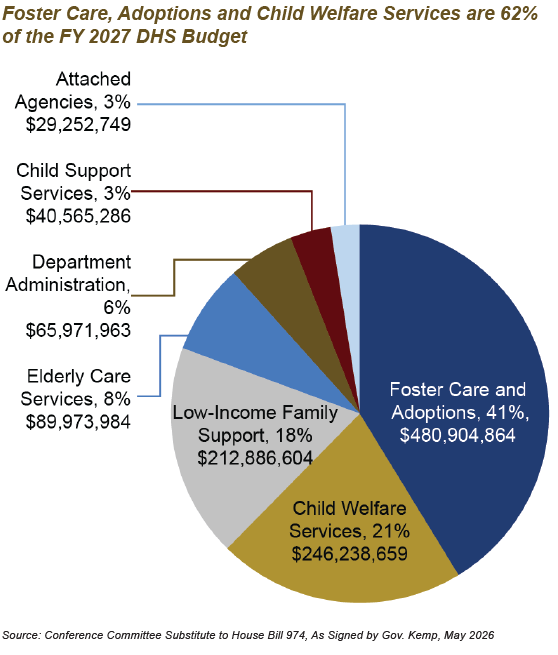
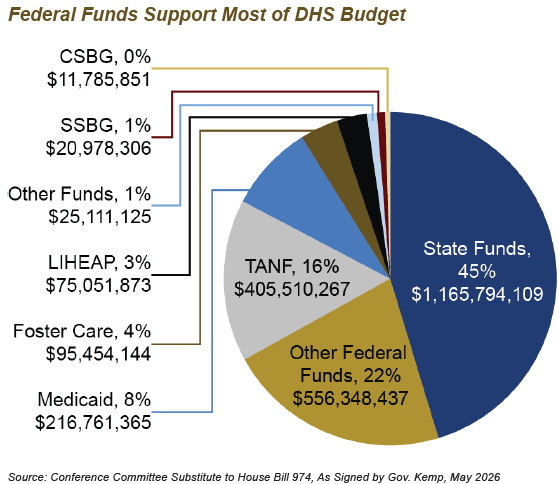
The Department of Human Services (DHS) oversees various functions, including foster care, child welfare and the administration of support for children and families with low incomes. The General Assembly included $1.2 billion in the FY 2027 budget for DHS, an increase of $105.9 million (10%) from the original FY 2026 budget.
DHS spends more than 60% of its budget on child welfare, foster care and adoption services, but only 18% on programs such as SNAP and TANF that are intended to help support Georgia families who make low incomes.
Human Services Impacted by Governor’s FY 2027 Budget Disregards
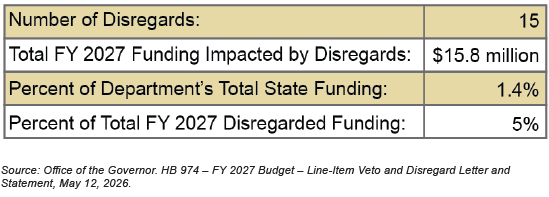
To partially offset the cost of more than $1.2 billion in income tax cuts approved through HB 463 (2026 Session), the Governor is directing DHS to disregard about $15.8 million in state funds. The disregards represent about 1.4% of the department’s total state funds but come at a time when the state is still reeling from a child welfare crisis that required emergency legislative hearings and significant state funding to address.
Significant budget disregards include:
- $2 million that would have partially funded the state’s participation in the SUN Bucks summer nutrition program, providing meals and snacks to students (split between DOE and DHS).
- $2 million to support caregiver support services for Georgia seniors.
- $1.5 million for child welfare services to support family reunification, youth exiting foster care and at-risk families.
- $1.2 million for child abuse and neglect prevention programs.
Federal Funding for the Department of Human Services
Federal funding comprises 54% of the DHS budget in FY 2027, a slightly smaller share than in the previous year (-0.8%). This funding covers Temporary Assistance for Needy Families (TANF), the Supplemental Nutrition Assistance Program (SNAP), Medicaid, Foster Care, Community Services Block Grant (CSBG) and the Low Income Home Energy Program (LIHEAP).
Last year, as part of H.R.1, Congress enacted the deepest cuts to SNAP in program history. The immediate effects of these cuts reduced federal funding for SNAP administration from 50% to 25% of costs, resulting in $46.4 million in additional state costs as part of the FY 2027 budget. In future years, the state will also likely be required to share program costs, which could range up to half a billion dollars annually depending on the state’s error rate. Error rates are caused by both client and caseworker mistakes and can include underpayments and overpayments. DHS received an additional $6.9 million to reduce the SNAP payment error rate in FY 2027.
Federal Changes and Increasing Costs Contribute to Significant Budget Changes in FY 2027
Going into the 2026 legislative session, appropriators were holding special legislative hearings to investigate an $86 million deficit in the DHS Division of Family and Children Services (DFCS) due to the rising costs of caring for children in the foster care system. At the same time, Georgia was preparing to absorb tens of millions in additional administrative costs for the SNAP program due to recent federal cuts.
After a wave of advocacy from Georgians statewide who called attention to the importance of these programs and services, the General Assembly responded by adding $50 million for foster care and $46.4 million for SNAP administration in the FY 2027 budget, along with at least $6.9 million to reduce Georgia’s SNAP error rate to help manage future costs. These funds were provided in addition to $81 million in the Amended Fiscal Year (AFY) 2026 budget to address the immediate deficit within DFCS and nearly $1 million to restore contracts previously cut by the agency in response.
In a missed opportunity, Gov. Kemp disregarded $2 million that would have allowed Georgia to participate in the new SUN Bucks summer nutrition program. This investment would have served as a downpayment on the state’s estimated total share of $5 million, which could unlock an estimated $143 million in additional federal funds to provide meals and snacks to students in the summer of 2027.
FY 2027 Budget for Georgia’s Correctional System
Several agencies oversee Georgia’s correctional system. The Georgia Department of Corrections (GDC) operates the state’s prison system, which houses about 50,000 people. The Department of Community Supervision (DCS) supervises 15,000 parolees and oversees more than 178,000 Georgians on probation. The State Board of Pardons and Paroles makes decisions over executive clemency. Finally, the Department of Juvenile Justice (DJJ) houses about 11,300 children in the correctional system and provides services to kids who are sentenced to probation or incarceration.
The General Assembly appropriated $1.7 billion for GDC in FY 2027, along with $227 million for DCS, $387 million for the DJJ and $21 million for the State Board of Pardons and Paroles. In total, nearly $2.4 billion in state funds will be spent in Georgia’s correctional system. An additional $8.5 million in federal funds is also administered through the state budget for these four agencies.
FY 2027 Correctional System Highlights:
- $28.5 million added to reduce the inmate to correctional officer ratio to one-to-13 in FY 2027. The General Assembly has set a goal of reducing this ratio to one-to-11 by the next budget cycle.
- $20.7 million added for the Criminal Justice Coordinating Council (CJCC) to provide grants and offset lost federal funds for victim service providers.
The Georgia Department of Labor FY 2027 Budget
The Georgia Department of Labor (DOL) is the state agency tasked with providing employment services for businesses and workers, maintaining workforce data and the Unemployment Insurance (UI) system.
The FY 2027 DOL budget is $11.7 million, an increase of $2.8 million over the FY 2026 budget (31%). These additional funds will go toward hiring 30 additional positions, including 10 employees working to replenish the Unemployment Insurance Trust Fund by reducing collection delinquency, 10 additional customer service positions and 10 financial auditor positions.
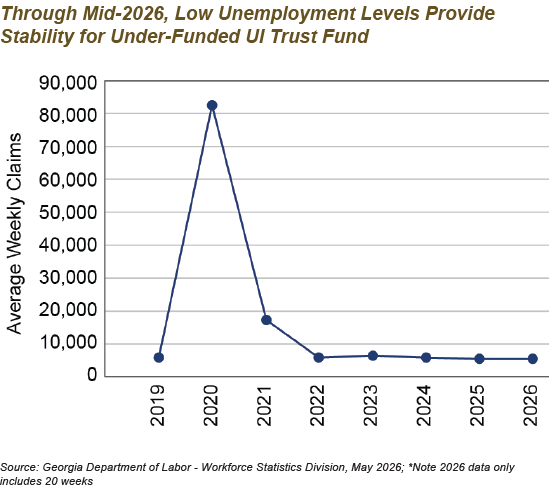
As of January 2026, the state’s UI Trust Fund reserve held $2.1 billion, below the federally recommended level of $2.9 billion. The best time to replenish the Trust Fund is when claims are low and ahead of an economic downturn when unemployment claims are likely to spike. Average weekly unemployment claims through May 2026 remain lower than any year during Gov. Kemp’s tenure, offering the General Assembly an opportunity to make these improvements before a potential downturn.