View more sections of the 2027 budget primer here.
This section of the Georgia Budget Primer was co-authored by Ashley Young and Daniel Kanso, PhD.

The Department of Early Care and Learning FY 2026 Budget
The Department of Early Care and Learning (DECAL) administers the following programs: Childcare and Parent Services (CAPS), pre-kindergarten and Quality Initiatives, a federally funded program that works to improve the quality and accessibility of childcare programs. It also includes Nutrition Services, which administers the federal Child and Adult Care Food Program and the Summer Meals program for low-income children in daycare facilities. State General Funds support CAPS (childcare scholarships for families with low-incomes) and Georgia Lottery funds support the pre-K program.
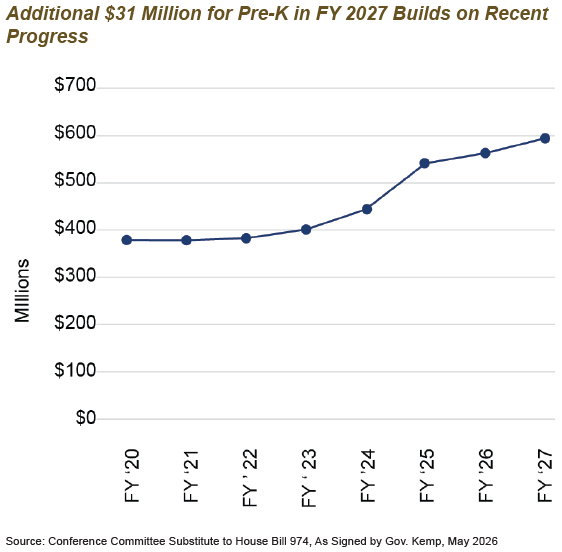
The FY 2027 budget includes $671.5 million in state funds for DECAL, with $77.5 million going to childcare and $594 million for pre-K. Overall, this marks a 5% ($31.1 million) year-over-year increase from FY 2026.
Georgia’s Pre-K Budget Continues Trajectory of Budget Increases While Child Care Remains Underfunded
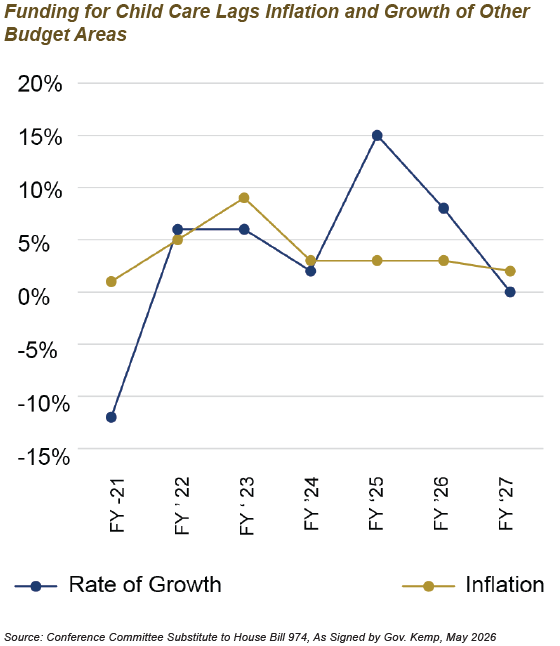
Over the past eight years, funding for Georgia’s pre-K program has grown by 57%, significantly exceeding inflation. At the same time, state funding for childcare has lagged, growing by just 25%. Inflation has increased by about 31% over the same period, meaning that state funding for childcare has lost ground.
Following two years of historic investments in Georgia’s Lottery-funded pre-K program, the General Assembly approved an additional $30.0 million in funding as part of the FY 2027 budget. These funds will cover year three of a four-year reduction in classroom size from 22 to 20 students, expand the extended day program to the pre-K priority group which includes children who are unhoused and those in foster care, and increase the amount of paid leave available to teachers.
By allocating $9.7 million to support the expansion of the pre-K extended day program, the FY 2027 budget also frees up $9.7 million in federal funds to expand the CAPS program to an additional 1,288 children. Still, state funding for child care remains stagnant and has been on a downward trajectory after Congress allowed expanded federal funding to expire in 2024. Previously, these funds provided more than 22,000 CAPS scholarships for students, in addition to enhancements to support providers. After enhanced federal funding expired, the state reduced the initial income eligibility level from 50% of the state median income to 30%, which is the lowest threshold in the country. Going into FY 2027, child care remains one of the most significant areas of unmet need in the state budget.
Georgia’s Department of Education Budget over the Past Eight Years
The Department of Education (DOE) serves over 1.7 million students in Georgia’s 2,300 public schools. The General Assembly appropriated $14.2 billion in state funds, 39% of the state’s total budget, to the DOE. This is a $480 million (4%) increase over the original FY 2026 budget. Over the past eight years, the DOE budget has increased by $3.5 billion (33%) or $365.5 million (3%) when adjusted for inflation. During this period, enrollment has dipped slightly from 1.72 million students to 1.71 million.
FY 2027 Department of Education Budget highlights
- $69.8 million added to account for increased State Health Benefit Plan costs for educators and school employees, in addition to $31.6 million directly appropriated to DCH to maintain financial stability, for a total of $101.4 million. The per-member-per-month cost will increase from $1,885 to $1,935, which will also require school districts to contribute $40.3 million in local funds.
- $70.4 million added to establish the implementation of literacy coaches in every elementary school as part of the Quality Basic Education (QBE) formula.
- $41 million cut for private school vouchers funded through the Georgia Promise Scholarship.
- $2.9 million added for student support services, including $1.6 million added for social work grants and $1.3 million more for mental health support grants.
- $15.3 million cut to eliminate the pilot program what could serve as a basis to establish a dedicated “opportunity weight” for students living in poverty.
Education Priorities Impacted by Governor’s FY 2027 Budget Disregards
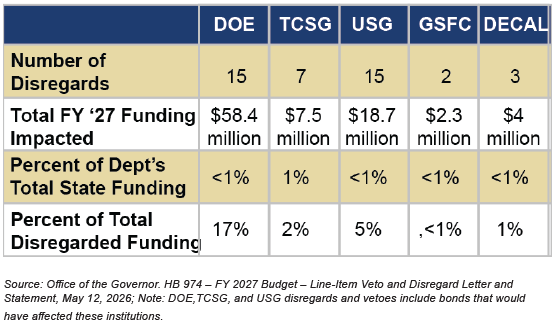
To partially offset new income tax cuts that primarily benefit the wealthy, the Governor removed funding across the five major education agencies using budget disregards and line-item vetoes.
Significant PreK-12 and higher education budget disregards and line-item vetoes include:
- $30.7 million for additional school transportation and support for bus operations.
- $12 million in bonds for financing $50 million in school safety equipment grants.
- $5 million for equipment needs at Central Georgia Technical College that would support Georgia’s health care workforce, despite these careers being listed in the statewide high demand career list.
- $2.7 million for one one-time grants that would allow school systems to purchase vision and auditory screening equipment, which was part of the General Assembly’s literacy package.
- $2.7 million in additional funds that would have covered the cost of substitute teachers during leave for Pre-K lead and assistant teachers.
- $2.5 million in additional out-of-school care for statewide and community grantees.
The Past Eight Years of QBE
The Quality Basic Education Act (QBE) is Georgia’s funding formula for public schools that was enacted in 1985. QBE is a weighted funding framework designed to ensure every K-12 student receives adequate education funding as promised under the state constitution. The formula considers three areas: direct instructional costs (such as the number of students and teacher salaries), indirect costs (such as maintenance and operations) and categorical grants (such as sparsity funding for rural students, student transportation and school nurses). The General Assembly continues to debate whether and how the funding formula should be revised to serve the modern-day needs of students.
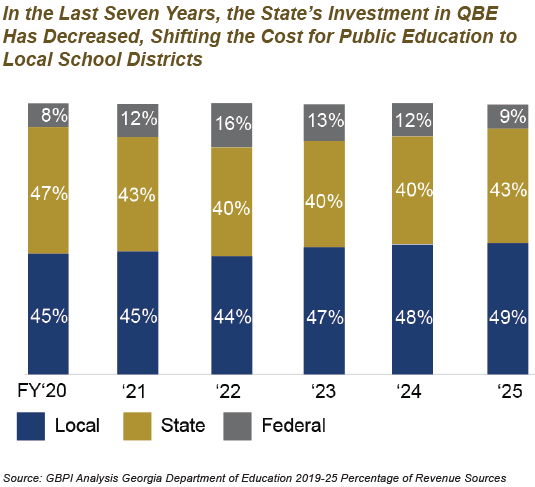
Public school funding is generated at the federal, state and local levels. Over the last eight years, the state has steadily decreased funding for public schools, shifting the cost burden to local districts. While the state generally funds certified staff such as teachers and school counselors, it does not share as much of the financial responsibility needed for school operations.
Three areas of school funding areas have experienced persistent underfunding, including health insurance costs for school employees, student transportation and equalization grants.
The State Health Benefit Plan (SHBP) is Georgia’s health insurance coverage for teachers and public school employees. A shift in 2011 required local districts to provide funding for SHBP coverage of “classified” school district employees, such as custodians, nurses and bus drivers, as well as other education positions funded at the local level.
Over the last eight years, the SHBP has significantly increased the per-member-per-month rate for non-certified staff from $945 in 2020 to $1,935 in FY 2027 (up 105%). In total, school districts will pay $798 million more for health insurance costs for their employees in FY 2027 reflecting increases since FY 2020.
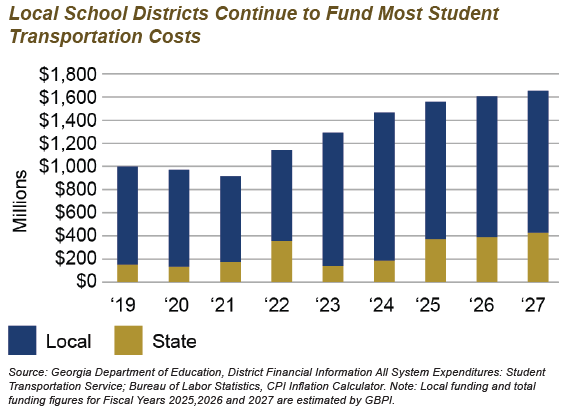
Although student transportation funding from the state increased by $237 million (175%) between FY 2020 and FY 2027, schools still lack adequate state funding to cover these rapidly increasing costs. In FY 2027, the state plans to contribute about 23% of $1.6 billion in estimated student transportation costs.[i] To restore Georgia’s historical 50-50 split between state and local funding seen during the 1990s, the state would need to invest about $431 million more annually for student transportation.
School Vouchers in Georgia
School vouchers divert critical funding from public schools by using state funds to pay tuition and related expenses for certain students at private schools, homeschools and other non-public settings.
Georgia’s Promise Scholarship was implemented in the 2025-26 academic year. It originally allotted 1% of QBE funding, roughly $141 million, for the voucher program. However, due to a lack of demand and qualified students, $41 million was cut from the FY 2027 budget, which now totals $100 million.
Earlier this year, Georgia opted into the Federal School Choice Tax Credit Program established through H.R. 1. This policy allows taxpayers to receive tax credits in exchange for making contributions to Scholarship Granting Organizations (SSOs) that fund scholarships for students enrolled at private schools. Since 2008, Georgia has also maintained its own Qualified Education Expense Tax Credit, which enables individuals and corporations to offset state taxes by contributing to SSOs.
While reducing funding for the Promise Scholarship voucher, lawmakers simultaneously increased the annual limit by $30 million for the state SSO tax credit. In the future, the SSO program will be capped at $150 million annually and will also be expanded to include military families and students with IEPs and 504 plans.
Property Tax Caps Reduce School Funding
Property taxes are the primary source of revenue for local governments, providing two-thirds of tax collections for cities, counties and schools in Georgia. School districts are most reliant on property taxes, which represent most local tax revenues ($10.2 billion in 2025). Education Special Option Local Sales Taxes (E-SPLOST) raise less than 20% of tax revenues and are constitutionally dedicated to funding building projects rather than instruction or operational costs.
In 2024, voters approved a constitutional amendment creating a floating statewide homestead exemption to prevent taxable home values on primary residences (also called assessed values) from increasing above the rate of inflation from year to year. When that measure was approved, local governments were given the option to opt out, and 68% of school districts and 30% of counties decided not to enact the measure, citing funding concerns.
This legislative session, the General Assembly passed SB 33 to remove the opt-out option for local governments, mandating floating homestead exemptions to cap property tax assessment increases to the rate of inflation. Historically, measures reducing property tax revenues in other states have led to larger class sizes and higher student-to-teacher ratios, which can negatively affect instructional quality and student success.[1]
Moreover, the state of Georgia has substantially reduced its funding commitments for schools in recent years, passing on higher health care costs, lowering the benchmark for the equalization formula and failing to keep up with higher student transportation costs. In the most recent school year, local school districts funded most education costs (49%) in comparison to the state (43%) and federal (9%) governments. State funding contributed 47% and local districts contributed 45% in 2020. As a result of increasing costs and shrinking tax bases, schools are likely to face greater budget constraints in future years, pushing them to consider increases in their millage rates, budget cuts or call for additional state funding to meet student needs. University System of Georgia
FY 2027 University System of Georgia Budget Highlights
Georgia’s four-year public higher education system, the University System of Georgia (USG), is composed of 26 higher education institutions located across the state. The total USG budget for FY 2027 is $3.9 billion, $256 million (7%) more than the original FY 2026 budget.
FY 2027 University System of Georgia Budget Highlights:
- $218.6 million added to reflect a 5% enrollment increase and corresponding square footage and instructor increases.
- $34.2 million cut from USG for online courses and instructor salaries.
- $9.5 million added to support the expansion of graduate medical education at the newly established medical school at the University of Georgia.
USG Funding Formula
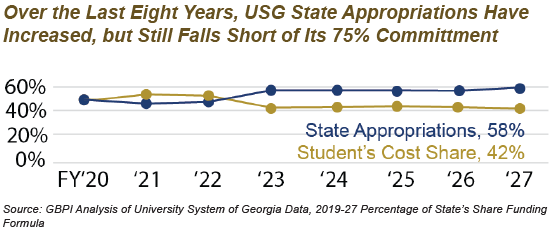
The University System of Georgia’s enrollment-based funding formula, developed in 1982, is used to compute funding to cover the cost of educating students. The USG funding formula provides that education costs are shared between the state (appropriations) and students (tuition), with the state historically covering 75% and students covering 25%.[2] Over the last 8 years, the USG funding investment has ranged from 47% to 58%. Due to consistent underfunding, USG has not covered its historical share of 75% of public college costs since 2001, leaving students to pay the difference in tuition.
Technical College System of Georgia
The Technical College System of Georgia (TCSG) governs 22 two-year post-secondary institutions that offer technical education, adult education and workforce development programs.
TCSG encompasses over 88 campus locations across the state and more than 600 programs. The total TCSG budget for FY 2027 is $564.1 million, $25.8 million (5%) more than the original FY 2026 budget.
FY 2027 Technical College System Budget Highlights
- $11.4 million in bonds added to finance $78.4 million in capital projects at various TCSG institutions.
- $34.1 million added to reflect a 9.4% increase in enrollment and a corresponding increase in square footage.
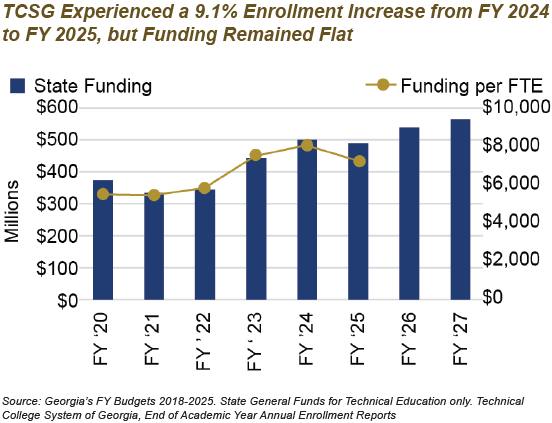
Over the last 8 years, TCSG enrollment has fluctuated, especially during the COVID-19 pandemic, dipping to 59,017 in FY 2022. Enrollment has steadily recovered since the COVID-19 pandemic. In 2025, enrollment in TCSG increased by 9.1% to a total of 67,795. Between FY 2020 and 2025, funding per student has also increased significantly from $5,494 to $7,216.
Georgia Student Finance Commission
The Georgia Student Finance Commission is the state’s higher education finance agency offering over 20 state and lottery funded scholarships, grants and loans. To ensure that students are prepared for post-secondary education, GSFC provides free financial aid counseling to K-12 schools, post-secondary institutions and community organizations.
FY 2027 Georgia Student Finance Commission Highlights
- $44.7 million added for HOPE Scholarships to meet projected enrollment at public colleges.
- $21.3 million added for Dual Enrollment to meet the projected enrollment.
- $4 million added for Tuition Equalization Grants, funding for Georgia residents who attend eligible private post-secondary institutions.
- $2.5 million to establish the Georgia Foster Care Scholarship.
- $1 million to expand the College Completion Grant program.
Newly Established Need-based Aid Program: DREAMS Scholarship
After Gov. Kemp announced need-based financial aid as a priority this year, the General Assembly passed legislation (SB 556) and allotted funding for the DREAMS Scholarship. Before this, Georgia was one of only two states that did not have comprehensive need-based aid to support students from households with low incomes pay for college.
With $325 million appropriated ($300 million to start an endowment to continually fund the program and $25 million for forthcoming scholarships), the DREAMS Scholarship is set to begin implementation in the 2026-27 academic year. Students can receive up to $3,000 per year based on their unmet need.
To be eligible for the DREAMS Scholarship, students must demonstrate financial need and be enrolled in a USG or TCSG institution. Students will also have to complete a financial literacy course and fulfill a work requirement (i.e., military service, internship, or volunteer).
The Georgia Student Finance Commission will serve as the fiscal partner for the DREAMS Scholarship, responsible for developing rules and regulations, disbursing funds to institutions and assessing the program’s progress.
Education Lottery Reserves
The Georgia Education Lottery was established in 1992 to provide funding for pre-K and post-secondary scholarships and grants for undergraduate students.
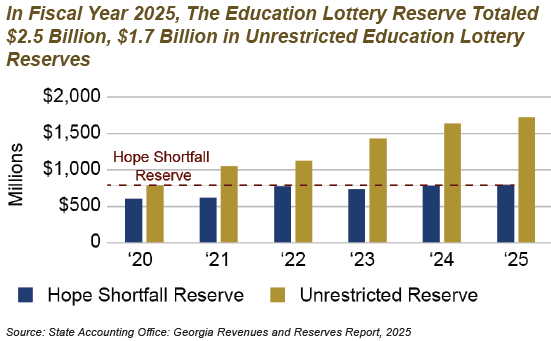
Under Gov. Kemp’s administration, the Georgia Lottery has consistently raised more revenue than projected. Once the required shortfall reserve is reached (50% of the previous year’s net lottery proceeds), additional funds are categorized as unrestricted lottery reserves. Between fiscal years 2020 and 2025, Georgia’s Lottery reserves have increased by $1.1 billion (82%).
At the end of FY 2025, the total education lottery reserves totaled $2.5 billion. The minimum balance (restricted reserves) for the Education Lottery amounted to $796.3 million at the end of FY 2025. The total unrestricted education lottery reserves were $1.7 billion, which by law can be used to fund pre-K programs or post-secondary scholarships and grants.
This year the requirements for maintaining the shortfall reserve were revised. The shortfall or restricted reserve now must maintain at least 50% of the preceding three years’ lottery net proceeds or lottery expenditures, whichever is higher. The three-year average (FY 2023-2025) for lottery proceeds remains approximately $45.5 million higher than the average for lottery expenditures.
Endnotes
[1] Figlio, D.N. (1998, March). Short-term effects of a 1990s-era property tax limit: Panel evidence on Oregon’s Measure 5. National Tax Journal 51, no. 1: 55–70. https://doi.org/10.1086/NTJ41789311; Nguyen-Hoang, P., and P. Zhang. (2022, January 1). Cap and gap: The fiscal effects of property tax levy limits in New York. Education Finance and Policy 17, no. 1: 1–26. https://doi.org/10.1162/edfp_a_00327
[2] Cook, T. (2022). Senate Study Committee on Excellence, Innovation, and Technology at Historically Black Colleges and Universities [PowerPoint slides]. University System of Georgia. https://www.senate.ga.gov/committees/Documents/HBCUsUSG10.26.22.pdf